
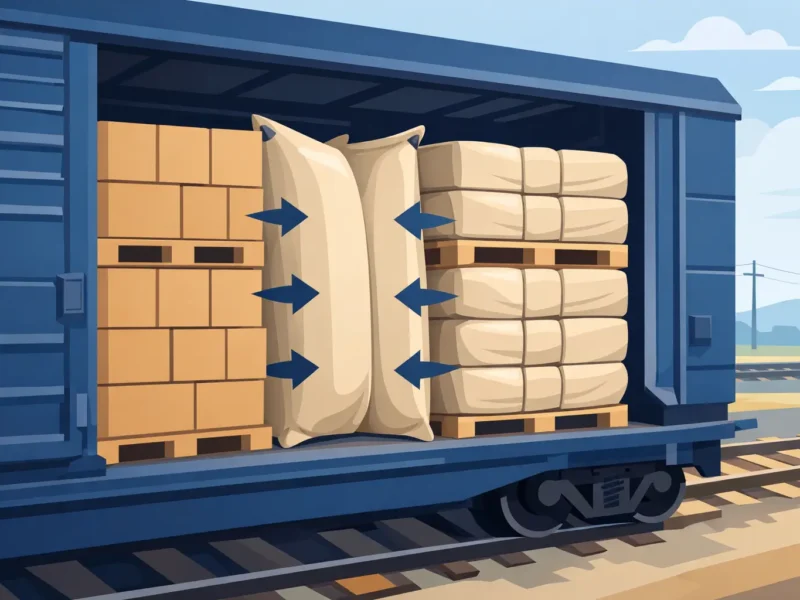
A damaged rail shipment rarely fails because of one big mistake. More often, it fails because small voids were left unmanaged, load pressure was underestimated, or the wrong securement method was used for the car, commodity, and trip conditions. Railcar dunnage bags are designed to solve that problem by filling lateral voids, stabilizing freight, and reducing the movement that leads to crushed packaging, broken product, and claim exposure.
For shippers moving palletized goods, paper rolls, packaged materials, metal products, or industrial freight, rail is efficient but unforgiving. Cars couple hard. Vibration is constant. Load forces can build over long distances and during yard handling. If cargo is not properly braced inside the available space, the cost shows up later as damage, rework, customer disputes, and wasted labor. That is why dunnage selection in rail is not just a packaging decision. It is a freight-risk decision.
What railcar dunnage bags actually do
Railcar dunnage bags are inflatable void fillers placed between cargo units to limit side-to-side or fore-and-aft movement, depending on the loading pattern and application. Once inflated to the proper pressure, the bag applies controlled force against adjacent loads and helps keep the shipment stable throughout transit.
The basic idea is simple, but performance depends on fit and application. A bag that is too small for the void will not provide enough contact area. A bag that is overinflated or used in the wrong orientation can fail early or apply pressure unevenly. In rail shipments, where forces can be more severe than standard over-the-road conditions, the margin for error is smaller.
Most buyers are not looking for a generic air bag. They are looking for a repeatable way to protect cargo in a specific rail environment. That means matching the bag to void size, load weight, package strength, and the nature of the rail route itself.
Why rail creates a different securement challenge
Truck and rail both involve movement, but railcar loading has its own set of variables. Impact during switching can create sudden force events that are far more aggressive than routine highway vibration. Long dwell times and temperature changes can affect internal pressure. Car interiors, load geometry, and blocking methods also vary more than many teams expect.
That is why railcar dunnage bags should not be selected the same way a warehouse might choose a light-duty truck bag. The load may look stable at origin and still shift after coupling impacts or repeated slack action. A practical rail solution has to account for what happens after the doors close, not just what looks acceptable on the dock.
This is also where material construction matters. Rail applications often call for bags with stronger outer layers, dependable valve performance, and consistent manufacturing tolerances. Lower-grade materials or inconsistent production can create avoidable risk, especially when the shipment value is high or replacement is difficult.
Choosing the right railcar dunnage bags
The right bag is a function of three things – the void, the load, and the trip.
Void size comes first because the bag has to fit the available space and still make broad contact with the cargo face. If a bag bridges the space without proper surface contact, it can become unstable under pressure. If it is too narrow or too short, it may not distribute force where the load actually needs support.
Load characteristics come next. Heavier freight, rigid packaging, and dense industrial products usually demand a more durable bag construction than lightweight consumer shipments. The compressive strength of the cargo matters as much as total weight. A strong bag against weak packaging can still result in damage if inflation pressure exceeds what the cartons or unitized load can handle.
Then there is the trip profile. Short-haul dedicated lanes may allow for more predictable loading conditions. Long-distance rail, interline transfers, and multi-stop networks increase exposure to impact and delay. In those cases, reliability and consistency become even more important than unit price.
Paper, woven polypropylene, and application fit
Different bag constructions serve different shipping environments. Kraft paper exterior bags are often selected for certain standard applications and can perform well when matched properly to the load. Woven polypropylene options are typically chosen when greater durability, moisture resistance, or tougher handling conditions are part of the equation.
There is no single best answer for every rail shipment. A buyer comparing options should look past basic product labels and focus on verified performance, burst strength, valve reliability, and consistency from batch to batch. If the same product performs differently from one order to the next, the real cost shows up in loading inconsistency and avoidable damage.
Inflation pressure is not a minor detail
Many loading problems come from treating inflation as an afterthought. Proper pressure is what turns the bag from a placeholder into a working securement component. Too little pressure allows movement. Too much pressure can overstress the bag or the cargo.
That is why inflator tools and valve quality matter. Fast fill times help loading efficiency, but controlled inflation is what protects the shipment. Teams loading railcars at scale need equipment that delivers consistent results across shifts, operators, and facilities.
Common mistakes that lead to rail damage
The most common problem is using a bag that was selected by habit instead of by application. A standard size may work in one car configuration and fail in another. When loading patterns change but the dunnage specification does not, damage risk rises quickly.
Another frequent issue is poor bag placement. Railcar dunnage bags need enough contact area and proper positioning within the void. If the bag sits too low, too high, or against an unstable surface, it cannot do its job. A well-made bag cannot compensate for bad placement.
The third issue is inconsistent operating procedure. One shift inflates to the correct pressure, another estimates by feel, and a third substitutes a different bag because inventory ran short. From a procurement standpoint, that is not only a training issue. It is also a supply issue. Consistent freight protection depends on having the correct product available when needed.
The cost question: cheaper bag or lower total risk?
On paper, lower-cost dunnage may look attractive. In practice, rail damage economics are rarely that simple. A cheaper bag may save a small amount per load while increasing the chance of cargo movement, rejected product, cleanup, claims, or customer dissatisfaction.
That does not mean every rail shipment requires the highest-specification bag available. It means the bag should be right for the risk level. For low-force applications, a standard construction may be entirely appropriate. For dense products, larger voids, or more demanding rail routes, paying for stronger and more consistent performance is often the less expensive choice over time.
Experienced buyers usually evaluate dunnage in terms of total shipment cost, not just unit cost. That is the right view. If the product protects the load, reduces claims, improves load speed, and performs consistently, it supports operations well beyond the packaging line.
Why quality control matters in railcar dunnage bags
In rail applications, quality control is not marketing language. It is a practical requirement. Bags should be manufactured with tight standards for material quality, sealing integrity, and valve performance. Testing matters because rail shipments expose weaknesses quickly.
This is one area where supplier discipline has a direct effect on shipping outcomes. Consistent raw materials, in-process testing, and post-production inspection help reduce variation that loaders cannot see at the dock. For buyers responsible for freight protection across multiple facilities, that consistency is valuable because it supports standard work and predictable results.
A supplier should also be able to help with product selection instead of pushing a one-size-fits-all answer. Void size, commodity, package strength, and transport mode all affect what works. Plastix USA serves this part of the market by pairing product supply with application guidance, which is often the difference between buying a bag and solving a rail damage problem.
Where railcar dunnage bags fit in a broader securement plan
Dunnage bags are effective, but they are not meant to replace every other securement method. Depending on the shipment, they may be used with blocking, bracing, corrugated fillers, or other load-stabilization materials. The right combination depends on the cargo and the railcar interior.
That is the trade-off many teams have to manage. A bag can improve speed and adaptability, but it still has to work within a complete loading method. If the shipment has unusual geometry, mixed packaging strength, or inconsistent pallet quality, the answer may involve more than one protective measure.
The most reliable results usually come from treating dunnage as part of a system rather than a standalone item. When the bag specification, inflation method, and loading procedure all match the freight, damage rates tend to follow.
Rail freight gives shippers strong cost and capacity advantages, but only when the load arrives in selling condition. If you are reviewing your current damage rates, loading standards, or bag specifications, railcar dunnage bags are one of the most practical places to start because small improvements in void control often prevent the expensive problems that show up at destination.