
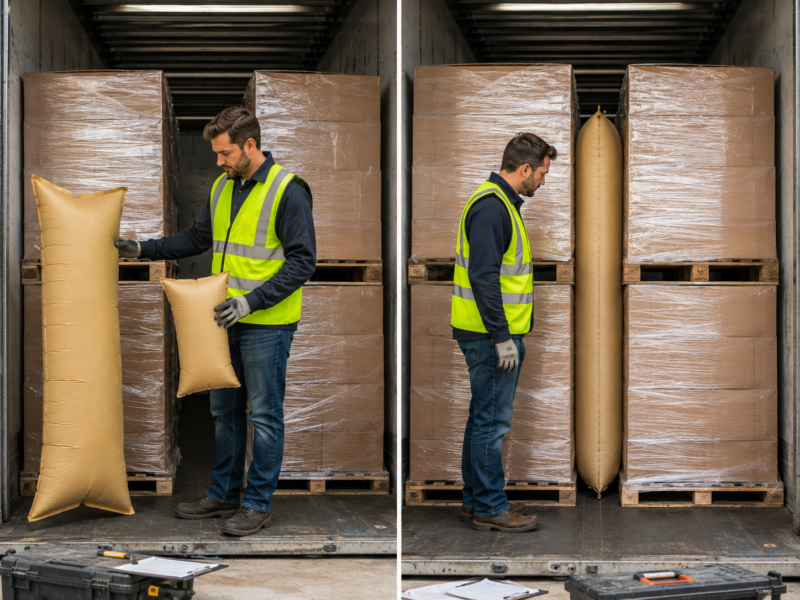
A load that looks tight at the dock can open up fast once it hits braking, vibration, and rail impact. If you are asking, what size dunnage bag do I need, the right answer starts with the gap you need to fill – but it does not end there. Bag width, bag height, load weight, and the mode of transport all affect whether the bag will stabilize the cargo or fail under real transit conditions.
Choosing the right size is not just about filling empty space. A dunnage bag has to make proper contact with the load, distribute pressure correctly, and stay within its working limits. If the bag is too small, it may shift, over-expand, or leave unsupported areas. If it is too large, it can be difficult to place, more likely to crease improperly, or simply add cost without improving performance.
What size dunnage bag do I need for my load?
The most practical starting point is the void, meaning the open space between cargo units or between the load and the trailer wall. Dunnage bags are selected to fill that space safely once inflated, not to force cargo apart. In most operations, the correct bag size is based on two core dimensions: the width of the void and the height of the area where the bag will contact the load.
Bag width should be slightly greater than the void width when deflated so the bag can expand into the space and create stable side-to-side contact. Bag height should generally cover a meaningful portion of the load face, not just a narrow strip. The goal is broad, even contact that helps resist movement across the full load surface.
That said, the void is only one piece of the decision. A narrow gap between light, stable pallet loads is a very different application from a larger void between heavy industrial products moving by rail. The same bag dimensions may not perform the same way in each case.
Start with the void size
In most shipping environments, the void width is the first measurement to confirm. This is the open gap the bag is expected to occupy after inflation. Dunnage bags are designed to fill voids within a specified range, and exceeding that range is where problems begin.
If a bag is used in a void that is too wide for its rating, inflation pressure can rise unevenly, the bag can balloon into unsupported space, and the load may still remain unstable. If the void is smaller than expected, an oversized bag may not sit properly before inflation and can be harder for operators to place consistently.
As a working rule, the bag should be matched to the actual void range in your shipment pattern, not the ideal drawing from a packaging spec. In real freight, loads vary. Pallets lean, cartons compress, and product dimensions shift. Measuring typical loaded voids on the floor often gives a better answer than relying on nominal pallet dimensions alone.
Height matters more than many shippers expect
A common sizing mistake is choosing a bag based only on the gap width and ignoring vertical contact area. The bag also needs enough height to grip the load face and spread force across a stable section of cargo.
A short bag placed against a tall pallet stack may technically fill the gap, but it concentrates force in a smaller zone. That can reduce stability, especially if the product has flexible packaging, corrugated cases, or uneven surfaces. A taller bag generally improves load engagement because it contacts more of the load and helps reduce localized pressure points.
At the same time, taller is not always better. The bag should sit within the supported load area, not extend into open spaces, deck irregularities, or weak product zones. Good contact is useful. Contact in the wrong area is not.
Load weight changes the sizing decision
When customers ask what size dunnage bag do I need, they often mean dimensions. In practice, size and performance rating go together. A bag that fits the void physically still has to withstand the force created by the cargo mass.
Heavier loads generate more pressure during braking, cornering, coupling, and vibration. This is especially relevant in rail and intermodal service, where impact forces can be much more severe than over-the-road trucking. In these applications, the bag size has to be considered alongside the bag level or strength classification, construction type, and allowable void range.
For lighter consumer goods, a standard bag may provide adequate restraint if the fit is correct. For dense industrial products, paper rolls, metal parts, building materials, or tightly packed pallet loads, the wrong bag can fail even if its dimensions appear correct. That is why bag selection should never be made on width and height alone.
Transport mode affects the answer
Truck, railcar, and intermodal shipments do not behave the same way. The right bag size for a dry van moving regionally may not be enough for a rail move with higher impact and longer transit time.
Truck shipments often involve lower shock loads, but frequent braking and lane changes still create load movement risk. Railcar applications typically require more conservative bag selection because cargo can be exposed to stronger longitudinal forces. Intermodal adds another layer, since containers may experience multiple handoffs and varying handling conditions.
The same void in two different transport modes may call for different bag constructions or inflation practices. If your freight moves through more than one mode, sizing should reflect the harshest part of the trip, not the easiest one.
Surface shape and load quality matter
Not every load face is flat, rigid, and uniform. Some shipments present clean pallet edges and square cartons. Others include drums, irregular bundles, slippery wrap, or mixed pallet heights. Those variables change how the bag contacts the cargo.
A bag performs best when it inflates against stable, reasonably even surfaces. If the product face is irregular, a larger contact area may help, but only if the underlying load can support the pressure. If the cargo is weak, damaged, or inconsistently stacked, increasing bag size alone will not solve the securement problem.
This is where field reality matters. A properly sized bag can only do its job if the surrounding load is built to accept and hold pressure. If the pallet collapses under load, the bag was not the real issue.
Common sizing mistakes
The first mistake is choosing a bag to fill the biggest possible gap in the trailer rather than the correct operational range. That often leads to overextension and poor performance.
The second is underestimating the need for contact height. A bag that only touches a small section of the load may inflate, but it will not control movement as effectively.
The third is ignoring load weight and transit severity. A dimensional fit is not the same as an application fit. This matters most in high-force environments and with heavy commodities.
The fourth is using one standard size for every lane and every SKU because it simplifies purchasing. Standardization can help operations, but only if the chosen size actually matches the majority of your shipment profile.
How to determine the right dunnage bag size
Start by measuring the typical void width after the trailer, container, or railcar is loaded. Then measure the usable height of the contact area on the load face. From there, review the cargo weight, product type, and shipping mode.
If the load is heavy, irregular, or moving by rail or intermodal, be cautious about selecting solely by dimension. You also need to confirm the bag’s performance level and intended application range. Inflation method matters as well, since underinflation and overinflation both reduce effectiveness.
For many shippers, the best approach is to evaluate a few recurring load patterns rather than trying to create one rule for every shipment. A plant may only need two or three approved bag sizes if those sizes are chosen around actual freight conditions instead of guesswork.
This is also where supplier support has real value. An experienced dunnage bag manufacturer can review void size, load weight, transport mode, and product characteristics together, then recommend a bag size and construction that aligns with both performance and cost control. That is usually more efficient than trial-and-error on live freight.
The practical answer
If you need a short answer to what size dunnage bag do I need, it is this: choose a bag that matches the measured void width, provides enough height for broad load contact, and is rated for the weight and transport conditions of the shipment.
That answer is simple, but the details matter. Freight damage rarely comes from a bag being off by an inch on paper. It usually comes from using the wrong bag for the actual forces in play.
When the load is valuable, repeat shipments are involved, or transit conditions are demanding, it pays to size the bag to the real application, not the assumption. A good dunnage bag should fit the gap, support the load, and perform consistently when the trailer leaves the dock. If there is any doubt, get the shipment reviewed before the next claim gives you the answer for free.