
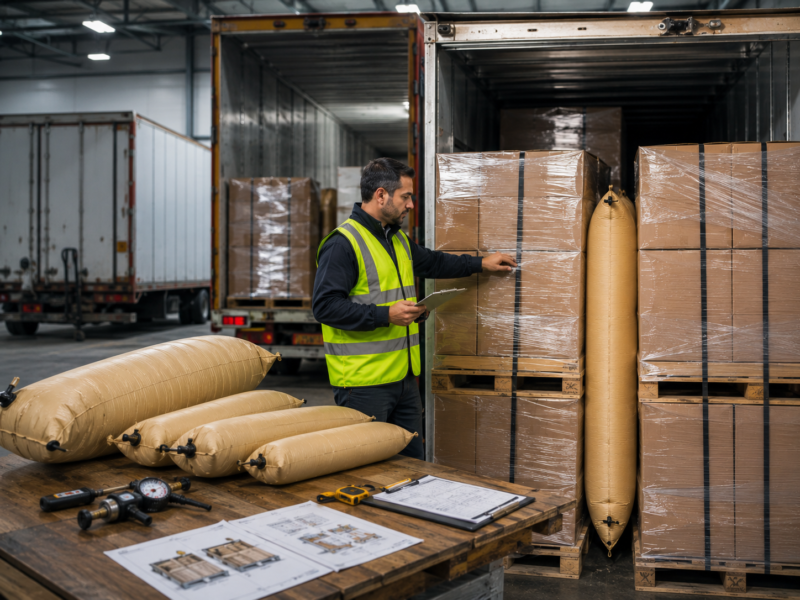
A shifted load does not usually start with a dramatic failure. More often, it starts with a small mismatch – a void that was wider than expected, a bag that was under-rated for the force involved, or an inflation setup that slowed the crew enough to cut corners. If you are evaluating how to choose dunnage bags, the right answer comes from your actual load conditions, not a generic bag chart.
For warehouse managers, freight coordinators, and packaging engineers, the goal is simple: keep cargo stable without adding unnecessary cost or complexity. That means choosing a dunnage bag that fits the transport mode, the void, the load weight, and the handling environment. A bag that performs well in one lane can be the wrong choice in another.
How to choose dunnage bags by application
The fastest way to narrow the field is to start with the application, not the product category. Truckload, railcar, and intermodal shipments create different forces. The same is true for palletized consumer goods, heavy industrial components, paper rolls, and bulk unitized freight.
In over-the-road truck shipments, vibration and routine braking are often the main concerns. In rail, impact forces during coupling and switching can be much more aggressive. Intermodal adds another layer because the load may be transferred between modes, extending transit time and exposing the cargo to varied handling conditions. If your freight sees rail or intermodal movement, bag performance requirements usually increase.
That is why bag selection should begin with a few practical questions. What is being shipped? How heavy is the load? How large is the void between units? What mode or modes will the freight travel? And how much pressure will the bag need to maintain over the full trip? Those answers determine whether a lighter-duty option is sufficient or whether a higher-strength construction is the safer and more cost-effective choice.
Start with void size and load geometry
Void size is one of the most common reasons a bag underperforms. If the bag is too small for the gap, it may not contact the load properly or may over-expand into an unstable shape. If it is too large, placement becomes awkward and inflation control can suffer.
Measure the actual gap where the bag will sit, not the estimated gap from a load plan. Real-world pallet overhang, uneven unit loads, and corrugated packaging can change the usable space. You also need to consider the contact surface. A narrow, irregular contact area places different stress on the bag than a broad, flat surface.
Bag dimensions should allow the inflated bag to fill the void while maintaining solid face contact with the cargo on both sides. This matters because dunnage bags work by bracing loads, not by acting as a cushion. If the geometry is wrong, the bag cannot transfer force evenly.
Why void shape matters as much as void width
Two loads can have the same gap width and still require different bag solutions. A clean rectangular void between stable pallet loads is straightforward. A tapered gap, a broken pallet profile, or a load with protrusions creates pressure points and uneven expansion.
In those cases, the stronger bag is not always the only answer. Sometimes the better answer is changing the bag size, repositioning the bag, or adjusting the load layout so the bag can contact more surface area. Selection is not just about maximum strength. It is about proper fit under actual shipping conditions.
Match bag strength to transport forces
Once void size is clear, the next step is strength level. This is where many buyers either overspend or accept unnecessary risk. Choosing the highest-rated bag for every shipment may sound safe, but it can increase cost and complicate inflation without improving results on lighter applications. Going too light, however, can lead to bag failure, load movement, product damage, and claims.
The right strength depends on the weight of the cargo being restrained and the force expected during transit. Truck shipments with stable palletized goods may be well served by one bag construction, while rail shipments with heavier loads often require a more durable option with higher burst and working performance. Material choice also matters here. Woven polypropylene, kraft paper exteriors, and polyethylene-based constructions each have practical roles depending on the environment and application requirements.
For buyers comparing options, the important point is this: strength ratings should be tied to a defined use case. Do not rely on appearance alone. A larger bag is not automatically a stronger bag, and a thicker-looking outer layer does not tell the full performance story. Testing standards, manufacturing consistency, and pressure retention are what matter in service.
Consider the shipping mode before you buy
If you are working through how to choose dunnage bags across multiple lanes, shipping mode should be treated as a core spec. Truck, rail, and intermodal are not interchangeable from a securement standpoint.
Truck freight generally involves lower impact than rail, but repeated vibration and stop-start movement still create shifting force over time. Railcar applications usually demand more from the bag because coupling impacts can be severe. Intermodal can combine long-duration vibration, handling transitions, and environmental variation. That added complexity often justifies a more conservative bag choice.
This is one area where operational habits matter. If your team uses one bag across every mode for simplicity, make sure that standard bag is rated for the most demanding condition in your network. Standardization can help purchasing and training, but only if it does not compromise cargo protection.
Evaluate bag construction and valve design
Bag selection is not only about size and force rating. Construction details affect inflation speed, ease of use, and consistency on the dock.
A well-made bag should inflate predictably, hold pressure reliably, and stand up to normal handling during placement. Valve quality plays a direct role. Poor valve performance creates air loss, slower installation, and frustration for the crew. That can turn a good securement plan into an inconsistent one.
For high-volume operations, inflation efficiency matters more than many buyers expect. If the valve and inflator setup are easy to use, teams are more likely to place and inflate bags correctly every time. If the process is slow or awkward, shortcuts follow. Over the course of hundreds of loads, that difference affects labor, throughput, and damage exposure.
Do not separate the bag from the inflator decision
A dunnage bag should be selected along with the inflation method. Manual and semi-automatic setups have different speed and control advantages, and the right choice depends on shipment volume and dock workflow. A bag that fits your load but does not fit your inflation process can still become a problem operationally.
If multiple shifts or facilities are involved, standardizing the bag and inflator combination can reduce training issues and improve fill consistency. That is especially useful when buyers are trying to reduce variation across locations.
Look at the total cost, not just unit price
Lowest unit cost is rarely the same as lowest shipping cost. A cheaper bag that fails in service or slows loading is expensive in practice. Claims, rework, rejected product, and labor disruption erase small purchase savings quickly.
The better approach is to evaluate cost in context. How often is the bag used? How much product value is being protected? How expensive is a damaged load? How much time does the crew spend installing it? In some applications, a higher-performing bag is the lower-cost decision because it reduces damage risk and improves loading efficiency.
This is also where supplier quality matters. Consistent manufacturing and testing reduce variation between orders. For B2B shippers, that consistency is not a marketing point. It is a control measure. When you reorder the same specification, you need the same field performance.
When to ask for application guidance
Some loads are simple. Others are not. If your freight involves unusual dimensions, high-value product, rail impact, mixed-mode shipping, or recurring damage issues, it makes sense to get application-specific guidance before standardizing a bag.
The best recommendations come from actual shipment details – cargo type, unit weight, void dimensions, mode of transport, and loading pattern. Samples and trial runs can also help validate the choice before a broader rollout. For many operations, that step prevents buying a bag based on assumption instead of performance.
A supplier with real manufacturing and application experience can usually identify issues that are easy to miss internally, such as overexpansion risk, poor surface contact, or a valve setup that does not match dock conditions. That outside perspective is valuable when the cost of being wrong shows up as freight damage.
At Plastix USA, that is often where the conversation starts: not with a generic product push, but with the actual load and the conditions it has to survive.
The best dunnage bag is the one that fits your void, matches your transport risk, and works cleanly with your loading process. If you choose with those factors in mind, you are not just buying packaging – you are reducing variability where freight damage usually begins.