
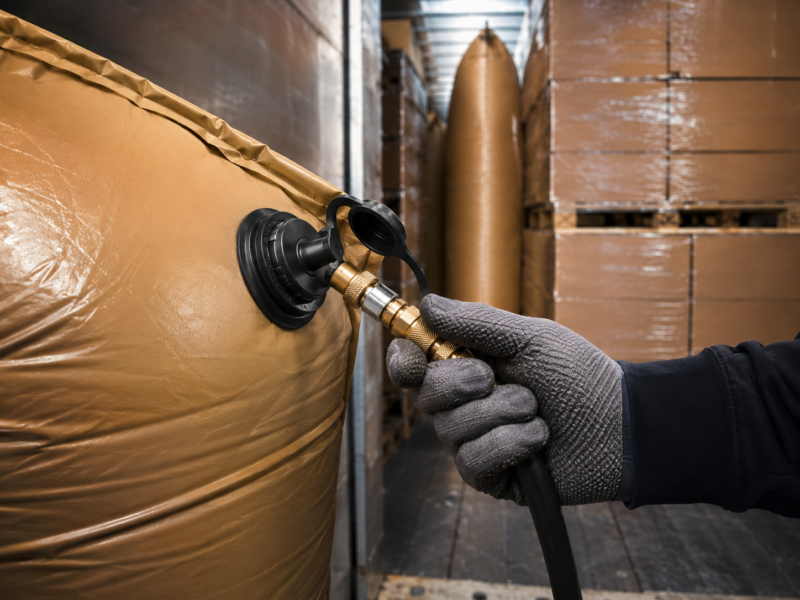
A dunnage bag can look identical on the floor, then perform very differently once the air goes in. In many shipments, the difference comes down to one small component: dunnage bag valves. If the valve is hard to connect, slow to fill, or inconsistent under pressure, your team feels it immediately in loading time, bag performance, and cargo stability.
For warehouse managers and packaging buyers, valves are not a minor accessory. They affect how fast crews can work, how reliably bags hold pressure in transit, and how well your inflation tools match the bag you are buying. When loads move by truck, rail, or intermodal, that connection between valve design and real-world performance matters.
Why dunnage bag valves matter more than they seem
Most discussions about dunnage focus on bag size, paper vs. woven construction, or working pressure. Those are valid considerations, but the valve sits at the point where product design meets daily use. It is where the operator interacts with the bag, where inflation begins, and where pressure retention can either support securement or undermine it.
A valve that seals properly helps the bag maintain intended pressure during transit. A valve that accepts the correct inflator cleanly reduces loading delays. A valve that is built consistently from one production run to the next supports standardized procedures across shifts and facilities.
That is why experienced shippers do not treat valves as interchangeable. Two bags may both be rated for the same application, yet one may be easier to deploy, faster to inflate, and less prone to user error because the valve design is better suited to the operation.
The main job of dunnage bag valves
At a basic level, a dunnage bag valve needs to do three things well. It must allow fast inflation, prevent unintended air loss, and hold up under normal handling before, during, and after installation.
That sounds simple, but each of those functions carries trade-offs. A valve designed for very rapid inflation can improve throughput, but if it requires a specific inflator setup, compatibility becomes more important. A valve with a very tight sealing mechanism can improve retention, but if it is awkward for crews to use with gloves or in tight trailer spaces, installation time may increase. Good valve selection is less about chasing one feature and more about matching the valve to the shipping environment.
Common valve considerations by operation type
High-throughput truck loading
In fast-paced dock operations, speed and ease of use usually lead the conversation. Teams loading outbound trucks often need bags inflated quickly with minimal training and minimal tool adjustment. In that environment, valve design should support repeatable connections and fast fill times.
If the valve and inflator pairing is clumsy, small delays stack up. A few extra seconds per load does not sound serious until it shows up across dozens of trailers per day.
Railcar and heavier-duty applications
Rail shipments place different demands on dunnage systems. Load movement can be more severe, and pressure retention becomes a bigger point of focus. In these cases, the valve is part of a larger performance equation that includes bag construction, outer material, and correct sizing for voids.
A buyer evaluating bags for rail should not look at valve performance in isolation. The real question is whether the valve performs consistently as part of a bag system designed for that transport mode.
Intermodal and mixed-mode shipping
Intermodal shipments introduce more variables. Loads may experience multiple handling points, varying transit conditions, and longer travel durations. Here, valve reliability and consistent sealing become especially important because the bag may need to maintain performance through a more complex journey.
Valve compatibility with inflation tools
One of the most common avoidable problems is a mismatch between bag valves and inflation equipment. Buyers sometimes focus on bag price first, then discover that their existing inflator tools do not fit the valve correctly or do not deliver the intended inflation speed.
That mismatch can create several problems at once. Crews may struggle to connect the tool, inflation time may increase, and improper connections can lead to underinflation or wasted air. In some cases, operators may improvise, which is exactly what you do not want in cargo securement.
Before standardizing on a bag, it is worth confirming how the valve interfaces with the inflator your team already uses. If you are changing valve style, it may make sense to review tool compatibility at the same time rather than treating it as an afterthought.
How valve quality affects consistency
For procurement teams, consistency is often more valuable than chasing the lowest unit cost. A valve that performs well in one shipment but varies from batch to batch creates operational risk. The dock crew notices it first. One bag fills easily, another resists connection, and another leaks sooner than expected. That variability slows loading and makes troubleshooting harder.
Consistent valve production supports predictable installation, pressure performance, and user confidence. This is where manufacturing controls matter. Materials, sealing quality, dimensional accuracy, and post-production inspection all influence whether a valve behaves the same way across repeated use cases.
Industrial buyers should ask a simple question: will this valve perform the same way next month as it did in the sample order? If the answer is uncertain, the cost of inconsistency can exceed any savings on paper.
Choosing dunnage bag valves with the full system in mind
Valve selection works best when it is tied to the full application, not just the component itself. That includes the type of load, product weight, void size, transport mode, and the pace of the loading environment.
For example, a warehouse shipping lightweight palletized goods by truck may prioritize inflation speed and operator convenience. A manufacturer shipping heavier products by rail may place more weight on bag construction and retention under more demanding conditions. Neither approach is wrong. The right valve depends on what the shipment actually requires.
This is also why samples and application reviews are useful. A valve that looks acceptable in a spec sheet may perform differently in a live loading environment with your team, your trailers, and your tools.
What buyers should ask suppliers about valve performance
Not every supplier gives the same level of detail on valves, but experienced buyers should push beyond basic product descriptions. Ask how the valve is tested, what inflator equipment is recommended, and whether the valve style is intended for the transport mode you are using.
It also helps to ask how the supplier handles quality control from production through delivery. A reliable supplier should be able to speak clearly about inspection standards, performance expectations, and whether the valve is part of a bag system built for the application you described.
That conversation often tells you as much as the product spec. If the answers stay vague, support may also be vague when a shipment issue appears.
Small component, real operational impact
Dunnage bag valves influence labor efficiency, inflation accuracy, and cargo protection in ways that are easy to overlook until something goes wrong. When a valve performs well, the loading process moves faster and the bag does its job with less friction. When it performs poorly, the problem shows up as delays, inconsistent installs, and a higher chance of load shift or damage.
That is why the best buying decision is usually not the cheapest valve or the most familiar one. It is the valve that matches your bag design, your inflation tools, and the actual shipping conditions your operation deals with every day. For companies that treat freight damage prevention as a process instead of a guess, that level of fit is where better results start.
If you are reviewing dunnage options, take a hard look at the valve before you place the order. A small part that works right can make the whole securement system easier to trust.