
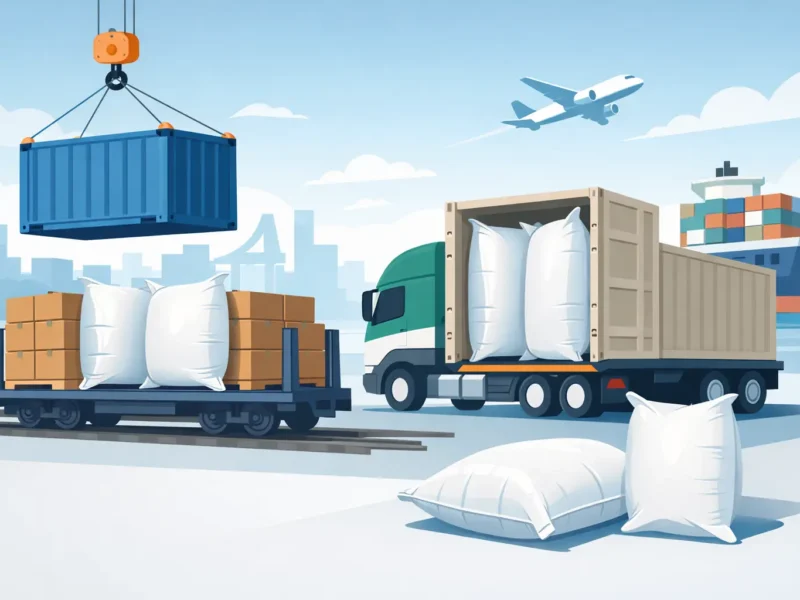
A load can leave the dock stable and still arrive with shifted product after one rail handoff, one hard brake event, or one poorly managed void between pallets. That is why intermodal load securement bags matter. In truck-to-rail and rail-to-truck moves, freight sees changing forces, repeated handling, and longer transit windows, so void fill and lateral restraint are not optional if you want to reduce damage and control claims.
For shippers moving palletized goods, paper products, food and beverage loads, building materials, or industrial components, the question is not whether to secure the load. The real question is whether the securement method matches the transport environment. Intermodal shipping creates a different risk profile than a single-mode truckload, and the securement product has to perform accordingly.
What intermodal load securement bags do
Intermodal load securement bags are inflatable dunnage bags placed in voids between cargo units to limit movement during transit. Once inflated to the correct pressure, they apply outward force against adjacent load surfaces and help stabilize freight inside trailers, containers, and railcars.
The concept is straightforward, but performance depends on details. Bag construction, size, valve quality, inflation control, and proper placement all affect results. A bag that is oversized, underinflated, or used against weak load surfaces can fail to do its job even if the product itself is made well.
In intermodal service, these bags are especially useful because freight often experiences different motion patterns across modes. Highway vibration, rail coupling impacts, cornering forces, and terminal handling all introduce opportunities for cargo shift. Dunnage air bags help absorb those gaps in load support when unitized product does not fully fill the transport space.
Why intermodal loads create higher securement risk
A direct truckload from one facility to one receiver usually has fewer transfer points and a shorter chain of custody. Intermodal moves are different. Freight may be loaded at origin, drayed to a terminal, transferred to rail, moved over a longer distance, then transferred again for final delivery. Every step adds exposure.
That added exposure changes the securement calculation. A load that seems stable for a short over-the-road run may not stay stable after rail impacts and extended vibration. The void between product stacks that looked manageable at the dock can become the space that allows a full pallet row to lean, compress, or collapse.
This is also where cost decisions can backfire. Using a lower-grade bag to save a small amount per load may lead to damaged inventory, rejected shipments, rework, chargebacks, or claim administration that costs far more than the packaging itself. For most industrial shippers, securement is a cost-control decision, not just a packaging line item.
Choosing the right intermodal load securement bags
There is no single bag that fits every load. The right choice depends on void size, load weight, transport mode, product geometry, and the strength of the surfaces contacting the bag.
For many applications, woven polypropylene dunnage bags offer a strong balance of durability and cost efficiency. Kraft options can also be a practical fit in certain shipping environments. The bag style matters, but rating and construction matter more. Intermodal loads often need a bag built for higher-performance conditions, particularly when voids are larger or cargo is heavy.
Size selection is one of the most common problem areas. If the bag is too small, it will not contact the load correctly. If it is too large, it can overextend into the void, become difficult to inflate properly, or apply force unevenly. The goal is controlled contact, not overstuffing the space.
Valve quality also deserves more attention than it usually gets. Inconsistent valves can slow down operations, affect inflation accuracy, and create leaks that reduce holding performance over transit time. In a busy warehouse, that translates into line delays and inconsistent results from one shift to the next.
Placement matters as much as product quality
Even high-quality intermodal load securement bags can underperform if they are placed incorrectly. The bag needs to contact stable load surfaces and sit in the right zone of the void. Placement too high, too low, or against damaged packaging can reduce effectiveness.
The strongest setup is one where the surrounding cargo is unitized well enough to accept and distribute the pressure. If pallet loads are already leaning, stretch wrap is compromised, or corrugated is too weak, the bag may simply push into the problem instead of correcting it.
That is why securement should be viewed as a system. Pallet condition, wrap integrity, load pattern, void dimensions, and transport mode all work together. A dunnage bag is highly effective when those basics are in place. It is not a substitute for poor palletization.
Inflation pressure is not a guess
One of the fastest ways to reduce performance is inconsistent inflation. Underinflation leaves too much movement in the load. Overinflation can stress the bag, the valve, or the cargo itself. In either case, the result is avoidable risk.
Using the right inflator tools and following the bag manufacturer’s pressure guidance is part of good operating discipline. This is especially important in multi-shift facilities where different teams may load similar freight in different ways. Standardized inflation practices improve consistency, reduce waste, and make securement outcomes more predictable.
Where these bags perform best
Intermodal load securement bags are commonly used when loads have lateral voids between pallet rows, between cargo units, or between product and the trailer or container wall. They are especially useful when the freight is heavy enough to shift dangerously but packaged in units that can safely accept controlled pressure.
Typical applications include consumer packaged goods, canned products, pulp and paper, appliances, industrial materials, and other palletized freight with repeatable geometry. They can also work well in mixed-load situations, though mixed freight usually requires more careful bag selection and placement because contact surfaces are less uniform.
There are also cases where another method, or a combination of methods, makes more sense. If the load has highly irregular shapes, weak packaging, or extreme void variation, you may need additional blocking, bracing, or unitization improvements alongside air bags. Good securement decisions are usually application-specific, not one-size-fits-all.
Operational benefits beyond damage prevention
Most buyers first look at dunnage bags as a way to reduce cargo damage. That is a fair starting point, but the operational value is broader than that.
A well-matched bag system can speed load securement compared with more labor-intensive methods. It can reduce the need for improvised blocking materials, keep loading procedures more consistent, and help warehouse teams secure freight without adding excessive complexity to the process.
It can also support procurement and quality goals. When you buy from a supplier with consistent manufacturing controls, reliable materials, and responsive application support, you are not just buying bags. You are reducing variability. For high-volume shippers, that consistency matters because small failures repeat quickly across hundreds or thousands of loads.
This is where experienced supply matters. Buyers need products that perform the same way from order to order and technical guidance that matches the realities of truck, railcar, and intermodal freight. Plastix USA works with that kind of requirement every day, where bag performance and response time directly affect shipping operations.
What to ask before you buy
If you are evaluating intermodal load securement bags, start with the application, not the catalog. Define the transport mode combination, the typical void size, the product weight, the pallet or unit load strength, and whether the load pattern is consistent from shipment to shipment.
Then ask practical questions. What level of bag performance is needed for the transport conditions? What inflation equipment will operators use? How much variability exists in the voids? Is the bag being used in a dry van, container, or railcar? Do warehouse teams need a faster valve style or a different form factor to improve throughput?
Those answers usually narrow the field quickly. The right product is the one that fits the actual load environment and can be used correctly by the people on the dock, every day, without guesswork.
Intermodal freight gives cargo more chances to move, shift, and absorb impact. The securement method should reflect that reality. When the bag type, size, placement, and inflation method are all aligned with the application, you get more than void fill. You get a more controlled shipment, fewer surprises at destination, and a loading process your team can trust load after load.