
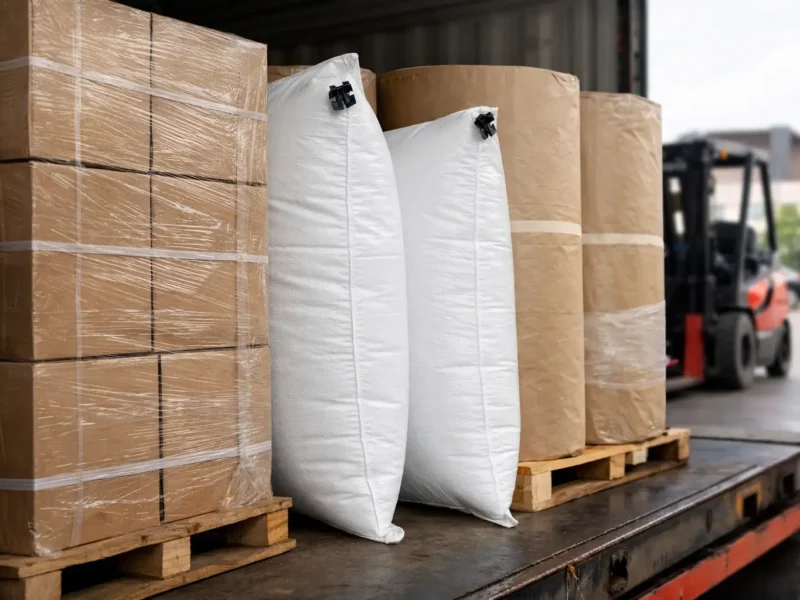
A load does not have to tip over to become a claim. More often, it shifts a few inches, rubs through packaging, crushes corner product, or arrives with enough movement damage to trigger a rejection. That is where kraft paper dunnage bags earn their place. When selected correctly and inflated to match the void, they help stabilize cargo, reduce movement in transit, and protect product value across truck, rail, and intermodal shipments.
For warehouse teams, packaging engineers, and freight managers, the appeal is simple. You need a void-fill and load-securement solution that performs consistently, fits your shipping profile, and does not slow down loading. Kraft bags are a practical option for many applications because they combine a durable outer construction with an inflatable inner liner that can absorb pressure and brace loads against lateral movement.
What kraft paper dunnage bags do
Kraft paper dunnage bags are inflatable cargo-securing bags designed to fill empty space between pallets, unitized loads, or other freight inside trailers, containers, and railcars. Once placed in the void and inflated, the bag applies controlled pressure against the adjacent cargo surfaces. That pressure helps prevent shifting during acceleration, braking, vibration, and impact.
The concept is straightforward, but the performance depends on matching the bag to the real shipping conditions. Void size matters. Load weight matters. Transport mode matters. A bag that performs well in over-the-road truck shipping may not be the right fit for railcar use, where impact forces can be much more severe.
In most kraft designs, the outer shell is made from multiple plies of kraft paper, while the internal bladder holds the air. The paper exterior gives the bag structure and grip, and the inner liner maintains inflation. This combination makes kraft bags a common choice for operations that need effective bracing without moving to heavier or more specialized securement systems.
Where kraft paper dunnage bags fit best
Kraft bags are often used in palletized freight, paper products, packaged food, building materials, industrial components, and consumer goods moving in unit loads. They are especially useful when cargo is strong enough to accept distributed pressure from an inflated bag and when the void between loads is consistent enough for reliable placement.
They can work well in truckload and intermodal applications where shippers need fast loading and dependable stabilization. In some rail applications, kraft bags are also used successfully, but the load profile has to be evaluated carefully. Rail shipments can generate higher shock loads, so bag level, construction, and working pressure become more critical.
This is where experienced product selection makes a difference. Not every gap should be filled with the same bag. If the cargo is light and easily compressed, overinflation can create problems. If the shipment is dense and heavy, an underspecified bag may fail before the destination.
Why buyers still choose kraft paper dunnage bags
There are several reasons kraft bags remain a standard option in industrial shipping. First, they are efficient. Loading crews can place and inflate them quickly, which helps maintain throughput at the dock. Second, they offer a good balance of cost and performance for a wide range of freight.
They also fit operations that want a straightforward, proven product. A properly manufactured kraft bag with consistent materials and dependable valve performance can support repeatable loading procedures across multiple facilities. That matters for companies trying to reduce cargo claims without adding unnecessary complexity.
Another advantage is handling. Kraft paper dunnage bags are generally easy to store, stage, and use, and they do not require major changes to trailer or container loading practices. For many shippers, that operational simplicity is part of the value.
What affects performance in the field
The biggest mistake buyers make is treating dunnage bags as interchangeable. They are not. Performance is shaped by a combination of bag quality, application fit, inflation method, and operator consistency.
Bag size has to match the void. If the bag is too small, it will not contact the load properly. If it is too large, it may fold awkwardly, inflate unevenly, or create unstable pressure points. The strength rating has to align with the load weight and transport severity. Paper ply count, inner liner quality, and valve construction all influence how the bag behaves under pressure.
Surface condition matters too. If the contact points are sharp, broken, or irregular, the bag may be exposed to abrasion or puncture risk. In those cases, edge protection or a different securement method may be needed. Inflation tools also matter more than some teams expect. Inconsistent fill pressure leads to inconsistent results, especially across multiple shifts or locations.
Choosing kraft paper dunnage bags by application
The right way to select a bag starts with the shipment, not the catalog. Look at the transport mode first. Truck shipments usually involve different force profiles than railcars. Intermodal adds another variable because the load may move through several handling environments before delivery.
Next, evaluate the cargo itself. Are you shipping rigid pallet loads, bundled materials, drums, cartons, or irregular industrial product? How much weight is pressing against the void? Are the load faces flat enough to make reliable contact with the bag? Then measure the actual gap you need to fill. Estimating by eye often leads to poor fit.
You also need to consider workflow. If your team is loading at high volume, valve type and inflation speed can affect labor time. If your operation ships a narrow range of products with consistent voids, standardizing on one or two bag sizes can improve training and purchasing efficiency. If your shipments vary widely, a broader mix may be necessary.
For that reason, many B2B buyers work with a supplier that can recommend bag type, dimensions, and inflation setup based on real use conditions. Plastix USA takes that consultative approach because cargo securement works best when the product matches the shipment, not when the shipment is forced to fit the product.
Kraft paper dunnage bags versus other options
Kraft bags are not the answer for every load, and serious buyers should look at the trade-offs. Compared with woven polypropylene dunnage bags, kraft paper dunnage bags can be a strong fit for many standard shipping applications, but woven options may be preferred where higher durability, moisture resistance, or more demanding handling conditions are involved.
Compared with blocking and bracing using lumber or other rigid materials, kraft bags are faster to install and generally lighter to handle. On the other hand, rigid securement may still be necessary for certain heavy, high-risk, or highly regulated loads. The right answer depends on the shipment profile, not preference alone.
The key point is that cost should be measured against total shipping risk. A cheaper bag that fails or underperforms is rarely cheaper once damage, labor, and customer impact are factored in.
Quality control is not a minor detail
On paper, many dunnage bags look similar. In use, the differences show up fast. Material consistency, valve reliability, burst resistance, and production quality all affect performance at the dock and in transit. For buyers responsible for repeat shipments, quality variation creates avoidable risk.
That is why testing and manufacturing standards matter. A supplier should be able to speak clearly about product construction, quality checks, and application guidance. If they cannot, the burden shifts to your operation to absorb the uncertainty.
For procurement teams, this is not just a technical issue. It is a supply issue. Consistent product quality supports consistent loading procedures, and that helps reduce damage frequency, retraining, and shipment exceptions. Over time, those gains are often more valuable than shaving a small amount off unit price.
Getting better results from kraft bags
Even the right bag can underperform if the loading process is loose. Teams should be trained to place the bag correctly in the void, avoid contact with damaging edges, and inflate to the recommended pressure. Bags should not be used as a substitute for poor pallet quality or unstable stacking patterns.
It also helps to review claim patterns. If damage is recurring on certain lanes, trailer types, or load configurations, the issue may be bag selection, inflation practice, or a combination of both. Small adjustments in bag size or level can make a measurable difference.
For operations shipping similar products every day, documenting the approved securement method is worth the effort. Standard work reduces guesswork, especially when labor changes or volume spikes.
Kraft paper dunnage bags do one job, but it is a job that affects product condition, customer satisfaction, and shipping cost all at once. When they are chosen with the actual load in mind and backed by dependable manufacturing, they become a practical control point in freight protection rather than just another packaging line item. If you are seeing load shift, recurring claims, or inconsistent securement across shipments, that is usually the right place to start asking better questions.