
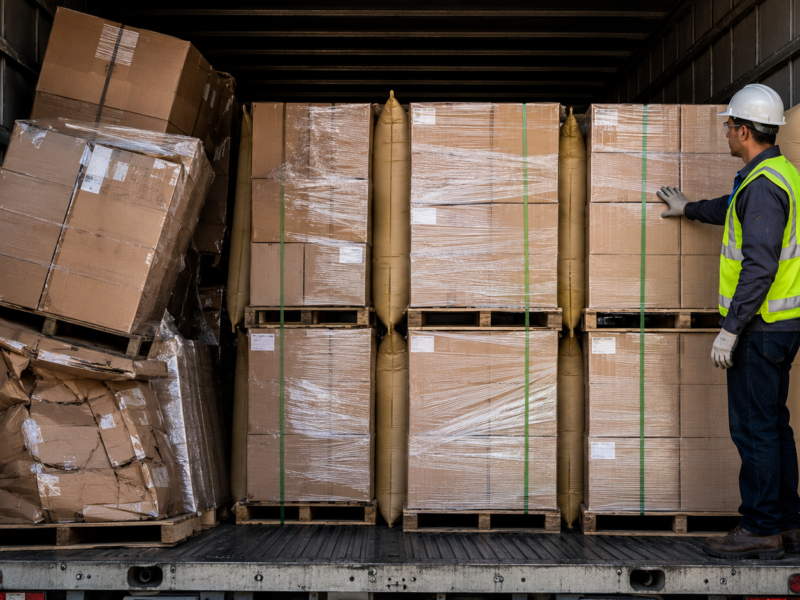
A load does not have to tip over to become expensive. A few inches of movement inside a trailer or container can crush corners, break wrap, deform cartons, and turn good inventory into a claim. If you are looking at how to prevent load shifting in transit, the answer usually is not one product or one rule. It is a securement system built around the cargo, the void, and the way that shipment will actually move.
Warehouse teams often see the same pattern. The freight leaves looking stable, but the securement plan was built for a calm dock, not for braking, vibration, rail impact, lane changes, and repeated handling. Preventing load shift starts earlier – at load planning – and it depends on matching the securement method to the real transport conditions.
How to prevent load shifting in transit starts with the load pattern
The first decision is not which bag or strap to use. It is how the cargo is arranged. Poor pallet quality, uneven weight distribution, overhang, and mixed-height stacks create instability before the trailer doors ever close. If the unit load is weak, the securement system has to compensate for problems it was never meant to solve.
A stable load pattern puts heavier product low, keeps weight centered, and minimizes unsupported edges. Cartons should sit flat, not bridge gaps. Pallets should be structurally sound and consistent in footprint when possible. If you are mixing SKUs, it helps to separate by weight and crush resistance rather than simply filling space as fast as possible.
Stretch wrap and banding matter here, but they have limits. They help maintain unit integrity. They do not reliably fill large voids or stop major side-to-side movement on their own. That distinction is where many damage issues begin.
Void space is where movement begins
Most in-transit movement starts with available space. If cargo can gain momentum, it will. Even a small gap can allow repeated shifting over a long route, especially in intermodal or rail applications where impact forces are more severe than many shippers expect.
Void control should be measured, not guessed. The width of the gap, the height of the load, the shape of the product, and the contact area all affect what securement method will work. A narrow, consistent void between stable pallet loads may be well suited for a dunnage air bag. A wide or irregular void may require a different configuration, added bracing, or changes to the loading pattern itself.
This is also where transport mode changes the answer. Truckload shipments often deal with braking and cornering forces. Rail shipments introduce higher longitudinal impact. Intermodal can combine both, along with longer transit times and multiple handling points. The same product may need a different void-fill approach depending on where and how it ships.
Not every void should be filled the same way
Operations teams sometimes standardize one bag size or one securement method across all lanes for purchasing convenience. That can reduce SKU count, but it can also create preventable failures. Undersized air bags can slip or underperform. Oversized bags can be difficult to place correctly and may not contact the load as intended.
The right solution depends on the load weight, void dimensions, and application. That is why bag type, level, and inflation method should be selected as part of the shipment design, not as an afterthought at the dock.
Unitizing and containment still do critical work
When people focus on how to prevent load shifting in transit, they sometimes jump straight to trailer-level securement and skip the basics of unitizing. That is a mistake. Dunnage air bags, blocking, and bracing perform best when the individual pallet loads are already stable.
If cartons are loosely stacked, if top layers are leaning, or if the wrap pattern does not hold the load to the pallet, the unit can deform under pressure. Once that happens, securement pressure drops and movement starts. In practical terms, that means better pallet wrapping, proper film tension, corner protection when needed, and banding for loads that tend to spread or settle.
There is a cost trade-off here. Stronger unitizing adds material and labor. But when compared with damaged product, rework, rejected deliveries, or chargebacks, it is usually one of the lowest-cost improvements available.
Use dunnage air bags where they fit the job
Dunnage air bags are one of the most efficient ways to restrain movement between loads when the application is right. They work by filling longitudinal or lateral voids and applying controlled pressure that helps keep freight in position during normal transport forces.
The key phrase is when the application is right. Bag construction, burst resistance, valve quality, inflation control, and load compatibility all matter. A lightweight bag or low-grade material may look acceptable during loading and still fail under actual transit conditions. Repeated vibration, compression cycles, and impact can expose weak materials quickly.
For truck, railcar, and intermodal shipments, selection should be based on more than just bag dimensions. You need to consider cargo weight, void size, surface conditions, and whether the load faces high-impact handling. Kraft and woven polypropylene designs each have use cases, and the choice should reflect the environment and performance requirement.
Proper inflation matters just as much as bag choice. Underinflation reduces contact and restraint. Overinflation can damage the bag, distort the load, or create unsafe pressure. Crews should use the correct inflator tools and a consistent process, especially in high-volume operations where speed can cause variation.
Bracing, blocking, and friction still have a place
air bags are effective, but they are not a replacement for all other securement methods. Some loads need a combination approach. Slip-prone pallets, irregular industrial components, drums, paper rolls, or heavy concentrated loads may require blocking, bracing, decking, anti-slip materials, or added containment at the unit-load level.
This is where experienced shipping teams usually outperform generic loading plans. They understand that securement is cumulative. Friction helps resist initial movement. Unitizing maintains shape. air bags fill voids. Bracing controls larger forces or unusual geometries. Remove one layer, and the whole system can become less reliable.
A simple example is a smooth pallet base on a trailer floor with a moderate center void. An air bag may control the gap, but if the pallet slides easily, movement can still occur. Adding anti-slip material or improving pallet-to-load containment can make the full setup perform much better.
Train for consistency, not just speed
Many cargo damage problems are process failures disguised as product failures. The bag size may be correct, but it was placed too low. The wrap pattern may be specified, but the shift crew varies it by operator. The void may have been measured once and then assumed for every shipment after that.
Standard work is what turns securement from theory into repeatable performance. Load diagrams, simple lane-specific instructions, bag placement guidance, inflation procedures, and final checks can reduce variation without slowing operations too much. In fact, clear standards often improve throughput because teams spend less time correcting unstable loads.
If you are seeing recurring claims on certain lanes, do not only inspect the damaged freight. Review how it was built, wrapped, loaded, gapped, and inflated. The root cause is often visible in the process before it is visible in the damage photos.
Match the solution to the mode and the claim history
The best way to improve load stability is to look at your own shipping data. Which products shift most often? Which customers report leaning or crushed loads? Which modes generate the highest claims? Patterns usually appear quickly.
For example, a food distributor shipping palletized cartons by truck may mostly need better void management and improved wrap discipline. A manufacturer moving heavy product by rail may need higher-performance dunnage bags and more deliberate bracing. An intermodal shipper may need both, plus stricter attention to load settlement over longer transit times.
That is why a one-size-fits-all program usually leaves money on the table. Better results come from aligning the securement method with the actual risk profile of the freight.
Quality matters because failure happens in motion, not on the dock
Securement products are easy to judge by appearance and hard to judge by performance until a shipment is already exposed to risk. That is why testing, material consistency, and manufacturing controls matter. A dunnage air bag that looks fine during loading but varies in strength, valve reliability, or material quality can create hidden exposure across hundreds of shipments.
For B2B shippers, consistency is the real value. You need products that perform the same way from order to order and support that is fast when a lane changes or a new application comes up. That is the difference between buying packaging and building a dependable cargo-protection process. Plastix USA works with that reality every day.
The goal is not to eliminate every variable in freight transportation. You cannot. The goal is to remove preventable movement by improving the load pattern, controlling the void, choosing the right securement method, and executing the process the same way every time. When those pieces line up, fewer shipments turn into claims, fewer loads arrive compromised, and your dock spends less time fixing problems that should never have left the building in the first place.