
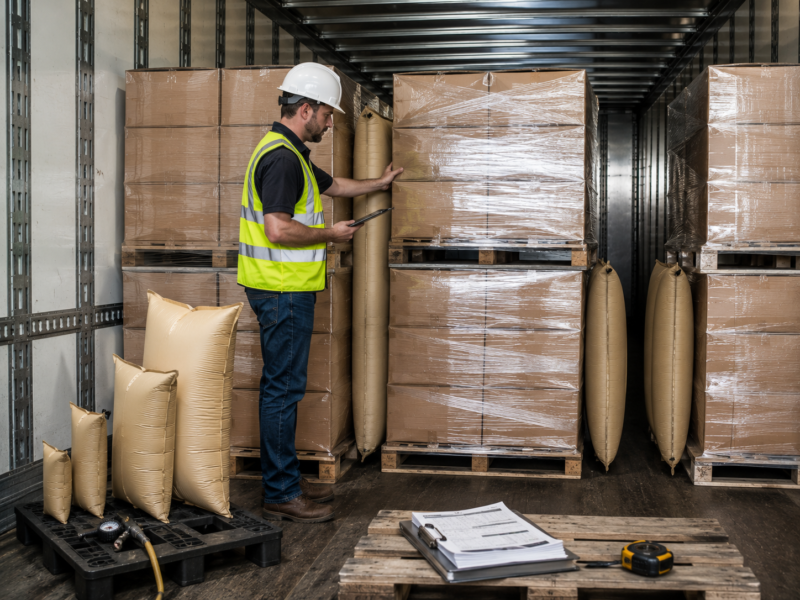
A pallet load can leave the dock looking tight and square, then arrive shifted, crushed, or partially collapsed after a few hundred miles of vibration and braking. That gap between stable at loading and stable in transit is exactly where dunnage bags for pallet loads do their job. When they are matched correctly to the void, load weight, and transport mode, they help control movement that stretch wrap and strapping alone often cannot.
For warehouse teams and freight decision-makers, the issue is rarely whether load securement matters. The real question is which method actually performs under real shipping conditions without slowing down the operation or adding avoidable cost. Dunnage bags are often the right answer, but only when the bag style, size, and inflation method fit the shipment.
Why pallet loads shift in the first place
Palletized freight is rarely damaged because one thing went wrong. More often, it is a combination of small factors that build during transit. Minor spacing between loads, uneven pallet heights, compressible packaging, trailer movement, and repeated acceleration all create opportunities for movement. Once that movement starts, product corners get crushed, cartons lean, and the load loses its original geometry.
This is especially common when pallet loads are stacked side by side with open voids between them. A wrapped pallet may hold itself together reasonably well, but it does not automatically stay fixed in relation to the next pallet. That distinction matters. Internal pallet stability and trailer load stability are not the same problem.
Dunnage bags work by filling those voids and applying controlled pressure between adjacent surfaces. The goal is not to over-compress the freight. The goal is to limit lateral movement before it becomes damaging movement.
Where dunnage bags for pallet loads make the most sense
Dunnage bags for pallet loads are most effective when the shipment has consistent voids that can be filled predictably and when the freight faces meaningful in-transit motion. Truckload shipments are a common application, particularly mixed loads or partial loads where pallet dimensions and carton strength vary. Rail and intermodal environments can make void control even more critical because impact forces and vibration patterns are more severe.
They are also useful when product damage creates downstream costs beyond the freight claim itself. A damaged pallet can mean rejected deliveries, labor to sort and rework product, inventory write-offs, and customer service issues. In those situations, the cost of a properly selected dunnage bag is usually small compared with the cost of one preventable shift event.
That said, dunnage bags are not a cure-all. If pallets are poorly built, overhung, broken, or significantly uneven, no air bag will fully correct those conditions. Good load quality at the pallet level still matters.
The key variables in bag selection
The right bag is chosen around the shipment, not the other way around. Void size is the first factor. A bag must be large enough to bridge the gap and contact the load correctly, but not so large that it is forced into an unstable shape. A bag that is too small may not restrain movement. A bag that is too large can bulge improperly and lose effectiveness.
Load weight is just as important. Heavier pallet loads create greater force during braking, cornering, and impact. That means the bag material and performance rating need to match the actual application. Light consumer goods, dense industrial components, and bulk packaged materials do not place the same demands on the bag.
Transport mode changes the equation as well. Over-the-road truck shipments often allow for one level of bag performance, while railcar and intermodal shipping may require a higher-strength solution. Buyers who use one bag across every mode sometimes create risk without realizing it. Standardization is useful, but only when the standardized item is strong enough for the most demanding condition it will face.
Material choice affects performance and handling
Not all dunnage bags are built the same, and material construction is more than a pricing issue. PP woven dunnage bags are commonly used where stronger outer construction and dependable performance are required. Kraft paper dunnage bags are also widely used and can perform well in many shipping environments. PE air bags may fit applications where different handling or cost considerations apply.
The practical difference comes down to durability, resistance to abrasion, valve design, inflation consistency, and how the bag behaves under pressure in the actual void. In a clean, controlled shipping pattern, several options may work. In rougher handling environments or for heavier loads, material quality and construction standards matter more.
For procurement teams, this is where the low-price option can become expensive. If a bag fails in use, inflates inconsistently, or varies from lot to lot, the labor loss and cargo exposure can outweigh any unit savings.
Inflation matters more than many teams expect
A good bag can still underperform if it is inflated poorly. Underinflation leaves too much movement in the load. Overinflation can stress packaging, create unstable pressure points, or damage the bag itself. Consistent inflation requires the right valve and the right inflator tool for the bag type.
This is often where operations see variation across shifts or facilities. One crew may apply bags correctly and get excellent results. Another may inflate by feel, use mismatched tools, or place the bag in the wrong location. The result is inconsistent load protection and confusion about whether the product works.
The fix is straightforward. Standardize the bag, the inflator, and the work instruction. A short training process usually has a bigger effect than adding more packaging materials. For many shippers, better consistency comes from simplifying the decision at the dock rather than giving loaders too many acceptable options.
Placement is as important as bag strength
A dunnage bag should contact stable load surfaces and fill the void where movement is most likely to start. If the contact area is weak, irregular, or highly compressible, the bag cannot transfer force effectively. Cartons with soft walls, uneven pallet faces, or protruding product edges often need extra attention.
Vertical placement matters too. If the bag is positioned too high or too low relative to the center of mass, the restraint may be less effective. In some cases, the shipment needs a combination of improved pallet build, better wrap pattern, and dunnage placement to perform the way the shipper expects.
This is why application guidance is valuable. Two loads may have the same pallet count and similar voids, yet require different recommendations because the packaging strength, product density, or transit profile is different.
Common mistakes when using dunnage bags for pallet loads
Most field problems come back to fit, not the concept itself. One common mistake is choosing a bag based only on the void width while ignoring pallet weight and shipping mode. Another is assuming stretch wrap can carry the restraint load after the bag is placed. Wrap helps unitize the pallet, but it should not be expected to replace proper void fill between pallets.
Teams also run into problems when they reuse methods across freight types without reevaluating. A setup that works for boxed consumer goods may not be suitable for pails, bagged materials, or palletized industrial parts. Surface shape and compression strength change how the bag performs.
Then there is the supply issue. If bag dimensions, valve quality, or material construction vary from shipment to shipment, operators compensate in inconsistent ways. That unpredictability shows up on the trailer floor and eventually in damage claims.
How to evaluate the right solution for your operation
The fastest way to improve results is to evaluate the actual shipping condition, not just the product catalog. Measure the void. Review pallet dimensions and weight ranges. Identify whether the freight moves by truck, rail, or intermodal. Look at how often loads are mixed, how much variation exists between shipments, and whether the packaging surface is rigid enough for effective bag contact.
It also helps to review failure points from recent claims or customer complaints. Was the issue side-to-side movement, fore-aft movement, carton crush, or pallet collapse? Dunnage bags solve a specific part of the securement problem, and identifying the real failure mode leads to better selection.
For many operations, support from an experienced supplier shortens the process. A manufacturer with testing discipline and application knowledge can recommend bag type, size, and inflation setup based on the load instead of pushing a generic item. That is often the difference between buying packaging and buying performance.
Plastix USA works with shippers that need that kind of practical fit – especially where load stability, quality consistency, and response speed directly affect warehouse efficiency.
When pallet loads are moving through busy docks, tight schedules, and multiple transit conditions, the best packaging choice is usually the one that prevents rework before anyone has to talk about a claim. Dunnage bags do that well when they are selected for the real job, not the assumed one.