
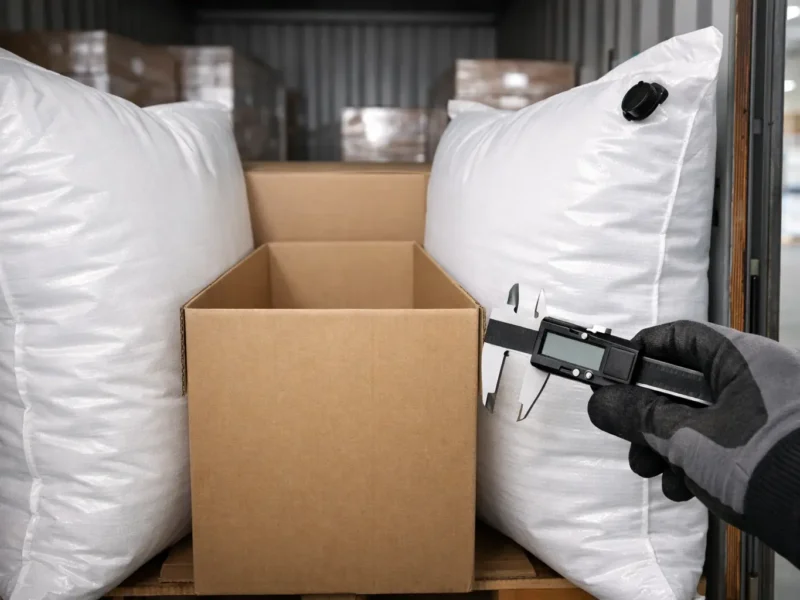
A load can be blocked, braced, and stretch wrapped correctly and still arrive damaged if the gap between shipments is wrong. That is why knowing how to calculate void space matters. If the gap is larger than expected, the bag may not stabilize the load. If it is smaller, you can overfill the bag, stress the paper or woven outer layer, and create avoidable risk during transit.
For warehouse teams, freight coordinators, and packaging engineers, void space is not a rough estimate. It is a working measurement that affects bag size, inflation pressure, load stability, and claim exposure. The goal is simple: match the dunnage bag to the actual gap and the transport conditions.
What void space means in freight loading
Void space is the open gap between adjacent cargo units, pallets, crates, or product stacks inside a trailer, container, or railcar. Dunnage air bags are designed to fill that gap and limit movement during normal transport vibration, braking, cornering, and impact.
The key point is that void space is not just a width measurement. In practice, you are evaluating three dimensions: the width of the gap, the height of the contact area, and the depth available between load faces. The gap width usually drives bag selection first, but the other dimensions determine whether the bag can make proper contact and distribute force safely.
A narrow but tall gap behaves differently from a short gap with uneven product surfaces. That is where many sizing mistakes happen.
How to calculate void space step by step
If you need a practical method for how to calculate void space, start with direct measurements at the point where the bag will actually be installed. Do not rely on nominal pallet dimensions or product specs alone. Real loads vary.
Measure the gap width
Measure the open distance between the two load faces where the dunnage bag will sit. This is the most important number. Take the measurement in inches, and check it at more than one point from floor to top if the load faces are irregular.
If the gap changes from top to bottom, use the narrowest true usable gap for safety and fit evaluation. A bag must expand into the space without being pinched at one point and unsupported at another.
Measure the contact height
Next, measure the vertical area where the bag can press against the load. This is not always the full height of the pallet or product stack. If the load has voids, overhangs, rounded surfaces, or broken stack lines, the real contact area may be smaller.
This measurement matters because a bag performs best when a substantial portion of its face contacts a stable, reasonably flat surface. If contact is limited, the bag may shift, bulge into open pockets, or apply force unevenly.
Measure the usable depth
Depth is the horizontal dimension of the space along the load face. In simple terms, it is how much face area is available for the bag to sit against. A bag that is too wide for the usable depth can fold or wrinkle. A bag that is too narrow may not distribute pressure effectively.
For many standard palletized loads, depth aligns closely with pallet dimensions, but not always. Corner posts, uneven cartons, and slip sheets can reduce usable contact depth.
Confirm load surface condition
Before final bag selection, check whether the load faces are flat, rigid, and strong enough for air bag application. Void space calculations only work if the surfaces can accept the lateral force created by inflation.
Lightweight cartons, unstable stacks, or damaged pallet loads may need a different securement approach or a different bag style and pressure setting.
A simple formula for rectangular gaps
When the gap is fairly uniform, you can calculate void space volume using a standard formula:
Void space volume = width x height x depth
If your gap is 4 inches wide, 48 inches high, and 40 inches deep, the void space volume is 7,680 cubic inches.
That said, volume alone does not determine the right dunnage bag. In cargo securement, bag performance depends more on gap width and contact area than on total cubic volume. A bag is not chosen the same way you would choose filler for a box. It must expand safely, brace the load, and maintain pressure under transit conditions.
So use the volume calculation as supporting information, not the only decision point.
Why the widest gap is not always the right number
One common mistake is measuring the largest visible gap and selecting a bag based on that number alone. In the field, that can lead to overexpansion or poor contact.
For example, if the center of the gap is 6 inches but the top and bottom taper to 4 inches, the bag will not inflate evenly. It will push hardest where resistance is lowest and may create pressure points where the load is weakest. In that case, the true working void is not a clean 6 inches.
The better approach is to measure multiple points and evaluate the actual shape of the gap. If the space is tapered, irregular, or interrupted by pallet decks or product overhang, the bag choice has to reflect those conditions.
How to calculate void space for different transport modes
Not every load environment behaves the same. The gap you can manage in over-the-road truck service may not be appropriate for rail or intermodal movement.
Truck shipments
Truckloads usually involve less severe impact than rail, but they still experience braking, lane changes, vibration, and road shock. In truck applications, moderate voids can often be managed effectively if the load is stable and the bag has solid contact surfaces.
The key is not to assume a loose fit is acceptable. Even in truck service, an undersized bag or an oversized gap increases movement and pressure loss risk.
Railcar shipments
Rail requires tighter control. Coupling impacts and higher longitudinal forces can place much greater stress on the bag and the load face. A gap that seems manageable in a trailer may be too large for the same bag in a railcar.
When calculating void space for rail, be more conservative. Confirm the actual gap, the cargo weight, and the strength of the load face before finalizing bag size and level.
Intermodal shipments
Intermodal combines handling events and transport conditions from multiple modes. That means more opportunities for load shift if the original gap measurement is off. In these cases, consistent measuring practices are especially important because small errors add up over long transit paths.
The trade-off between bag size and gap size
Bigger is not automatically better. An oversized bag in a small gap can be overinflated before it seats correctly, increasing the chance of bag damage or load distortion. A bag that is too small may balloon into the center of the gap without creating enough stable contact on the load faces.
This is where practical experience matters. You are not just filling space. You are creating controlled lateral restraint.
The best fit depends on the gap width, load strength, contact area, and mode of transport. It also depends on whether the bag is kraft, woven polypropylene, or polyethylene and how it is rated for use.
Common mistakes when measuring void space
The most frequent problem is measuring once and assuming the entire load is uniform. That works only when the pallets are consistent, square, and tightly built. In real shipping environments, loads lean, cartons crush slightly, and dimensions vary by production run.
Another issue is measuring empty trailer width and backing into a gap estimate from pallet count. That method ignores pallet spread, product overhang, and loading variation. A final gap should always be checked after the load is staged.
Teams also run into trouble when they ignore load-face condition. Even if the void is measured correctly, the bag may not perform as intended if it presses against weak cartons, broken boards, or unstable stack patterns.
When to use field judgment instead of math alone
There is a point where measuring is not enough by itself. If the load is irregular, the product is heavy, or the shipping mode is demanding, judgment matters just as much as the formula.
For example, a clean 5-inch gap between rigid pallet loads is one situation. A 5-inch gap between soft-sided product stacks with uneven faces is a different one. The number is the same, but the bag recommendation may not be.
That is why experienced shippers look at the whole application: product type, weight, stacking strength, trailer or railcar environment, and inflation method. Plastix USA works with customers in exactly these kinds of application-specific decisions because the right answer depends on the load, not just the tape measure.
A practical standard for better bag selection
If you want more consistent results, treat void space measurement as part of your loading process, not an afterthought. Measure the actual installed gap. Check more than one point. Confirm the usable contact area. Then match the dunnage bag to the shipment conditions, not just the widest opening.
That extra few minutes on the dock is usually cheaper than a damaged load, a rejected delivery, or a preventable claim. Good cargo protection starts with getting the gap right.