
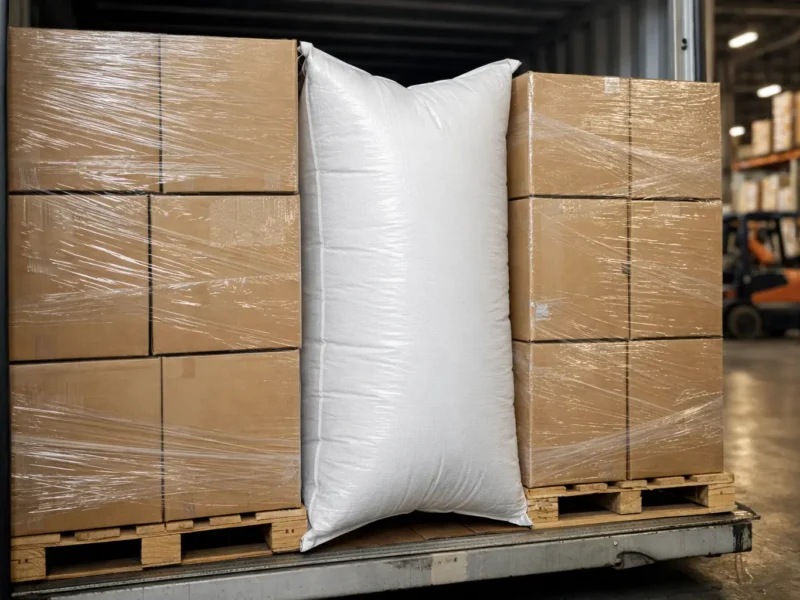
A load can leave the dock looking tight and arrive with crushed cartons, shifted pallets, and a claim nobody wants to own. In many cases, the problem is not the product or the trailer. It is the empty space between units of cargo. A dunnage bag is designed to fill that void and control movement before vibration, braking, and impact turn a stable load into damaged freight.
Thank you for reading this post, don't forget to subscribe!For warehouse teams, packaging engineers, and freight managers, that sounds simple because it is simple in concept. The challenge is choosing the right bag, the right material, and the right inflation setup for the job. A bag that performs well in one shipment can be the wrong choice in another if void size, transport mode, or load weight changes.
What is a dunnage bag?
A dunnage bag is an inflatable void-fill device placed between cargo units to restrain lateral movement during transportation. Once positioned in the open space between loads, the bag is inflated to apply controlled pressure against the cargo. That pressure helps stabilize the shipment and reduce shifting caused by normal transit forces.
You will also hear terms like dunnage air bag, cargo air bag, or inflatable void filler. The purpose is the same – protect freight by filling space and improving load stability. Dunnage bags are commonly used in truckload, railcar, and intermodal shipments where empty gaps can allow pallets, cartons, drums, or bulk goods to move.
This is not a one-size-fits-all product category. Performance depends on how well the bag matches the application. Material construction, burst resistance, working pressure, valve quality, and inflation control all matter when freight value and claim exposure are on the line.
Why a dunnage bag matters in transit
Most freight damage does not come from a dramatic accident. It comes from repeated small forces over time. A trailer accelerates, brakes, corners, and absorbs road shock. A railcar adds coupling impacts and sustained vibration. Intermodal creates longer travel chains with more handling points. If cargo has room to move, it usually will.
That movement creates more than visible damage. It can break stretch wrap, lean stacked product, deform cartons, split pallet loads, and make unloading less safe. Even when the goods are technically intact, a shifted load can create delays, rework, rejected deliveries, and customer complaints.
A properly selected dunnage bag helps reduce those risks by limiting free movement inside the shipment. It can also improve loading efficiency compared with more cumbersome blocking methods, especially when the goal is to secure palletized product quickly without adding excessive material or labor.
The trade-off is that the bag has to be used correctly. Poor placement, under-inflation, over-inflation, or using a light-duty bag in a heavy-duty application can leave the load vulnerable. The bag is part of the securement system, not a shortcut around good loading practice.
How dunnage bags work
The working principle is straightforward. The bag is inserted into the void between cargo units or between cargo and the transport wall, then inflated with air through a valve system. As the bag expands, it conforms to the available space and presses against the load surfaces.
That contact creates resistance to lateral movement. Instead of cargo shifting into open space during transit, the bag absorbs and distributes force across the contact area. The result is a more stable load and less opportunity for impact damage.
Inflation control matters here. Too little air and the bag does not provide enough pressure to restrain movement. Too much air and the bag may be overstressed or apply uneven force to the cargo. The right inflator tool and valve combination helps operators fill the bag quickly and consistently, which is especially important in higher-volume shipping operations.
Common dunnage bag materials and formats
Material choice affects durability, cost, moisture resistance, and fit for transport mode. In most industrial shipping environments, buyers are comparing woven polypropylene, kraft paper, and polyethylene-based options.
PP woven dunnage bags are widely used because they offer strong construction and dependable performance across many freight applications. They are often a practical choice for shippers looking for a balance of durability, value, and consistent handling.
Kraft dunnage bags are common in applications where a paper exterior is preferred. They can perform well, but the shipping environment matters. Moisture exposure, abrasion, and stacking conditions can affect how suitable a kraft construction is for a given load.
PE airbags are often selected where flexibility, moisture resistance, or specific handling preferences come into play. As with any bag type, the right answer depends on the cargo, the void, and the transportation conditions.
This is where experienced product guidance matters. Two bags may look similar on a spec sheet yet perform very differently under real transit stress.
Choosing the right dunnage bag for the job
The best starting point is not the bag. It is the shipment profile. Load weight, void size, product shape, packaging strength, and mode of transport should drive the selection process.
Void size is critical. A bag must be sized to fill the gap correctly without being stretched beyond its intended range. An undersized bag may not make proper contact. An oversized bag may be difficult to place or inflate correctly.
Load characteristics also matter. Stable pallet loads with strong, flat surfaces are easier to secure than irregular or fragile products. If the cargo face is weak, the bag can only perform within the limits of what the product packaging can withstand.
Transport mode changes the performance requirement. Over-the-road truck shipments may allow one level of bag specification, while railcar applications often call for more demanding performance because of higher impact forces. Intermodal can fall somewhere in between depending on the route and handling conditions.
Procurement teams often focus first on unit price, which is understandable. But the lower-cost bag is not always the lower-cost decision. If it leads to load failure, replacement shipments, customer deductions, or claim administration, the savings disappear fast. The better question is whether the bag is matched to the risk.
Using a dunnage bag correctly
Even a well-chosen bag can underperform if loading practices are inconsistent. The bag should be placed where it can contact stable load surfaces and fill the targeted void effectively. It should not be used where sharp edges, protrusions, or damaged packaging can puncture the material.
Operators should use the correct inflator and follow the recommended fill process for that bag style and application. Consistency matters. When crews are rushing to close trailers, variation in inflation pressure is one of the easiest ways to create avoidable problems.
It also helps to view dunnage as one part of a broader cargo-securement approach. Stretch wrap, pallet quality, unitizing method, trailer condition, and loading pattern all influence the outcome. A dunnage bag cannot compensate for a poorly built pallet or an unstable stack.
Where buyers usually get it wrong
One common mistake is choosing by appearance instead of performance data. Another is assuming all valves and inflation tools are interchangeable in practice. Small differences in air retention, fill speed, and ease of use can affect line efficiency and field results.
Some teams also underestimate how much shipment conditions vary by lane. A load that performs well on a short regional truck route may need a different approach for long-haul intermodal or rail. If your operation ships across multiple modes, standardizing around a single bag type can be efficient, but only if that product truly covers the range of conditions.
Quality control is another point buyers should take seriously. In cargo securement products, consistency matters as much as headline specs. Manufacturing discipline, testing, and raw material standards affect whether the product arriving at your dock performs like the product you approved.
That is one reason many industrial buyers work with suppliers that can do more than ship cartons. They need application guidance, sample support, and fast answers when load conditions change. Plastix USA serves that need by combining product availability with selection support for specific shipping requirements.
When a dunnage bag is the right solution
A dunnage bag is a strong fit when your core issue is void space between cargo units and the load can safely accept lateral pressure. It is especially useful when you need a fast, scalable method for reducing load shift across repeat shipments.
It may be less effective when packaging is too weak, cargo geometry is highly irregular, or the shipment requires a different form of blocking and bracing. That does not mean airbags are off the table. It means the application needs a closer look before standardizing.
The right product decision usually comes from asking a few practical questions early: what is moving, how much does it weigh, how large is the void, and what forces will it see in transit? Once those answers are clear, bag type, size, and inflation method become much easier to define.
Freight damage rarely starts with a major failure. More often, it starts with a small gap that was left unaddressed. Choosing the right dunnage bag is one of the simplest ways to close that gap before it turns into cost.
Recent Comments