
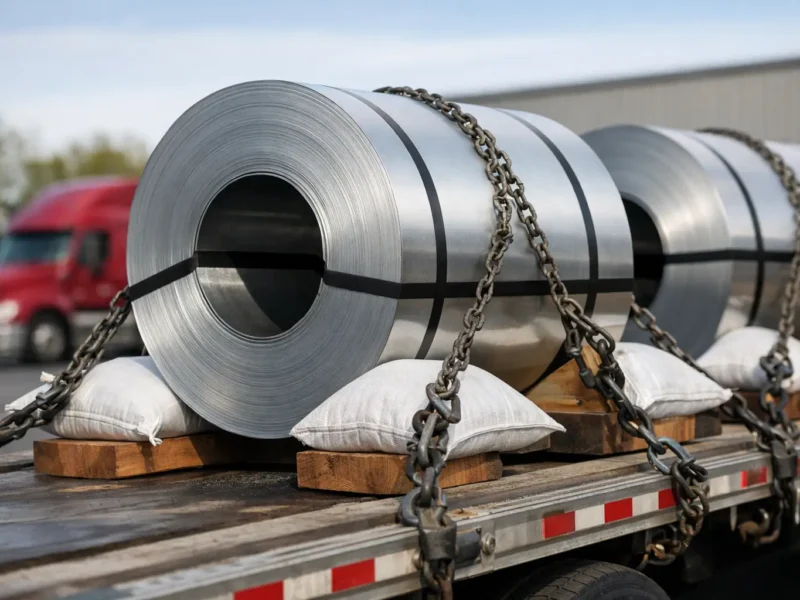
A steel coil that shifts even a few inches can turn a routine shipment into damaged product, a rejected load, or a serious roadside hazard. That is why load securement for steel coils has to be approached as an engineered process, not a last-minute warehouse task. Coil weight, orientation, trailer condition, route, and void space all affect whether the load stays stable from origin to delivery.
Why load securement for steel coils is different
Steel coils are difficult cargo because their mass is concentrated in a compact footprint. A single coil can generate extreme force under braking, cornering, vibration, and impact. Unlike lighter palletized freight, coils do not need much movement to create damage. Small shifts can crush packaging, break securement materials, deform adjacent freight, or compromise trailer walls and floors.
The shape adds another layer of risk. A coil loaded eye-to-the-side behaves differently from one loaded eye-to-the-sky. A bare coil on inadequate friction material can slide. A coil with open voids around it can build momentum. If the trailer floor is worn, wet, or contaminated, the securement plan that looked acceptable on paper may fail in transit.
For warehouse and transportation teams, the key point is simple: steel coils demand a load-specific securement method. General cargo practices are not enough.
Start with the load, not the hardware
Too many securement decisions begin with whatever straps, timbers, or air bags are already on hand. That approach usually creates inconsistency. A better process starts with the actual shipment conditions.
First, confirm the coil weight, diameter, width, and orientation. Then look at how many coils are moving, whether they are identical, and how they will be positioned in the trailer or railcar. A single heavy coil centered on a trailer creates one set of forces. Multiple coils loaded in sequence create another, especially if there are gaps between units.
Transport mode matters too. Over-the-road trailers see braking, lane changes, rough pavement, and dock impact. Rail shipments introduce repeated coupling shock and longer-duration vibration. Intermodal adds transfer points and handling variables. The securement method has to match the forces the load will actually see.
The core elements of coil securement
Effective load securement for steel coils usually depends on several systems working together, not one product doing all the work.
Blocking and bracing
Blocking and bracing create physical resistance to movement. Saddles, cradles, chocks, timber blocking, and engineered bracing structures help keep the coil from rolling or sliding out of position. This is often the first line of defense because it addresses the coil’s geometry directly.
The limitation is that blocking only works when it is properly sized, correctly placed, and strong enough for the load. Poorly fitted blocking can loosen during transit. Weak lumber can crush. Improvised bracing can shift under repeated impact.
Tie-down systems
Chains, straps, and other tiedown assemblies add restraint and help keep the coil seated in its intended position. They are critical, but they are not a substitute for proper load support. Restraint without stable positioning can allow the load to work against the tiedown system until something gives.
Tiedowns also depend on anchor point ratings, edge protection, proper tension, and ongoing compliance with cargo securement requirements. If the tie-down angle is wrong or the contact points are not protected, securement strength can degrade quickly.
Friction management
Friction mats and anti-slip materials can improve resistance between the coil, support structure, and trailer floor. This can reduce sliding risk and support the rest of the securement system. But friction is not a stand-alone answer for steel coils. Surface contamination, moisture, scale, and floor wear all affect actual performance.
Void control
Void space is often overlooked, but it matters. If there is room for a coil or adjacent materials to move, that movement creates force. Dunnage solutions can help eliminate or reduce open gaps so the load has less opportunity to shift, especially in multi-unit shipments or mixed securement patterns.
Where dunnage air bags fit
Dunnage air bags are not a replacement for coil-specific tiedowns, cradles, or blocking. They do, however, play an important supporting role in many steel shipments where voids exist between coils, between the load and a wall, or between adjacent units in rail and truck applications.
Used correctly, air bags help fill space and apply consistent pressure that limits lateral movement and load migration. This is particularly useful when coils are shipped with related products, separator structures, or staged load patterns that leave measurable gaps. In those cases, the air bag becomes part of a broader securement plan that improves stability and reduces impact between cargo units.
The phrase used correctly matters here. air bags must be matched to the void size, load profile, and transport mode. Under-sized bags can fail to control movement. Overinflated bags can burst or create uneven pressure. Weak materials may not hold up to heavy industrial freight. Inflation tools and valve quality also affect field performance.
For buyers evaluating dunnage for steel applications, consistency matters as much as nominal strength. Bag construction, testing, and material quality determine whether the product performs the same way from load to load. That is one reason many shippers prefer working with a supplier that understands cargo-securement variables instead of simply selling commodity packaging.
Common failure points in steel coil shipments
Most coil securement problems are not caused by one dramatic mistake. They come from a chain of smaller decisions.
One common issue is relying too heavily on a single method. If a team assumes straps alone will manage a heavy coil, or that blocking alone is enough without considering voids and vibration, the margin for error gets tight. Another issue is poor load-to-trailer fit. An uneven floor, damaged anchor points, or bad weight distribution can undermine an otherwise sound plan.
Packaging teams also run into trouble when they standardize one securement method for every coil. That may be efficient on paper, but coil dimensions, weights, and destination routes vary. What holds for a short regional run may not be adequate for rail or long-haul intermodal.
Then there is execution. Securement products can be specified correctly and still fail if personnel rush the loading process, skip inspection, or inflate air bags without verifying proper placement. Consistency in the warehouse is just as important as product selection.
What to evaluate before choosing securement materials
If you are building or refining a coil securement program, start by reviewing actual shipment conditions instead of catalog specs alone. The practical questions are straightforward. How much void space is present? What direction is movement most likely? Are you securing one coil or several? Is the load moving by truck, rail, or both? What kind of trailer or car condition are you working with?
You also need to look at repeatability. A securement method that works only when your most experienced loader is on shift is not a reliable system. Materials should be easy to apply correctly, available in consistent quality, and supported by clear guidance on sizing and use.
Cost matters, but claims cost more. The lowest-cost material is rarely the lowest-cost decision if it leads to damaged coils, rejected deliveries, cleanup time, or carrier disputes. In industrial shipping, dependable performance usually wins over short-term savings.
Building a stronger process for load securement for steel coils
The strongest securement programs combine product selection with loading discipline. That means documented methods, trained personnel, inspection routines, and suppliers who can help match materials to actual freight conditions.
For some operations, that may involve upgrading friction support or revising cradle design. For others, the bigger improvement is better void management between coils or at the ends of the load. In facilities shipping varied steel products, it often makes sense to standardize decision rules rather than force a single securement setup onto every load.
This is where experienced support has real value. A supplier that understands dunnage performance, inflation equipment, bag sizing, and transport variables can help remove guesswork from the process. Plastix USA works with shippers that need that kind of practical guidance, especially when the goal is not just to buy material, but to reduce movement, damage, and rework across repeated shipments.
Steel coils will always be demanding cargo. The goal is not to eliminate every variable. It is to control the ones you can with a securement plan built for the actual load, the actual mode, and the actual risks on the route. When that happens, cargo protection improves, claims drop, and the load arrives the way it left.