
A shipment does not have to be visibly wrecked to become a claim. Often the trailer arrives on time, the stretch wrap still looks intact, and the receiving team only finds damage after the pallets are broken down. That is usually where the real question starts – how to reduce product breakage without adding unnecessary material, labor, or freight cost.
For most shippers, breakage is not caused by one failure. It comes from a chain of small misses: the wrong box strength, too much empty space, poor pallet patterns, weak containment, or load movement that was never controlled inside the trailer or railcar. If you want fewer claims and more consistent deliveries, the answer is not simply “more packaging.” The answer is better packaging decisions and better load securement decisions working together.
How to reduce product breakage starts with failure points
The fastest way to cut damage is to stop treating all breakage as a packaging problem. In freight, products break for three basic reasons: the product itself is unsupported, the package cannot absorb or resist transport stress, or the unitized load shifts during transit.
Truck, rail, and intermodal shipments create different force profiles. Over-the-road freight sees vibration, hard braking, cornering, and dock impacts. Rail adds heavier longitudinal shock. Intermodal combines multiple handling events with longer transit exposure. A package that performs well in a controlled parcel environment may fail once it is stacked in a trailer with side-to-side voids or sent through rail transitions.
That is why damage analysis has to move beyond the damaged carton. Look at where the product sat in the load, how high it was stacked, whether there was void space between loads, whether the pallet was overhanging, and whether containment was designed for storage rather than transportation.
Start with the product and package fit
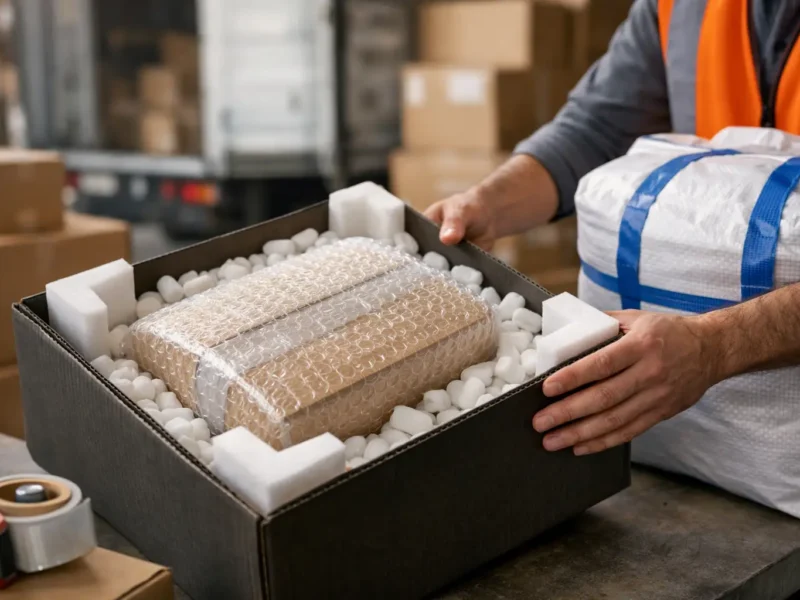
If the product can move inside its own package, the outer load has already lost part of the battle. Fragile, high-density, irregular, or top-heavy items need internal support that matches their risk. That may mean corrugated partitions, molded inserts, foam, edge protection, or tighter carton sizing.
Too much void fill is often treated as a fix, but loose fill does not solve every problem. Heavy items can migrate through it. Sharp edges can cut through surrounding material. A better approach is to match the cushioning method to product weight, geometry, and drop sensitivity.
Carton specification matters just as much. If the board grade is selected only by static stacking assumptions, it may fail under vibration and clamp pressure. Packaging engineers should review compression strength, moisture exposure, and actual shipping conditions, not just warehouse stacking time. A box that is good enough in storage can still collapse in transit.
Pallet quality and load building do more than most teams realize
A strong package on a weak pallet still breaks. Broken deck boards, inconsistent pallet dimensions, poor nail retention, and overhang all increase the chance of tipping, crushing, and fork damage.
Load pattern matters as well. Column stacking may improve compression performance for some cartons, while interlocking can improve stability in other cases. There is no universal answer. It depends on carton strength, unit load height, trailer conditions, and whether the shipment is likely to face repeated handling.
Stretch wrap should also be treated as a measurable control, not a visual finish. If containment force is inconsistent, the load can walk across the pallet during vibration. If wrap is too tight, it can deform cartons and damage contents. If it is too loose, it does not stabilize anything. Many breakage problems blamed on carriers are actually unit load failures that started before the truck was loaded.
Common unit load mistakes
The most frequent issues are simple: overhang that crushes bottom cartons, underhang that reduces support, mixed-SKU pallets with uneven weight distribution, and unstable top layers that encourage leaning. These are not minor details. They change how force travels through the load.
Control movement inside the trailer or railcar
This is where many expensive products are lost. Once there is open space between loads, cargo can build momentum. Even a few inches of lateral or longitudinal movement can turn a stable pallet into a damaged claim.
If you are serious about how to reduce product breakage, void management has to be part of the shipping process. Empty space should be measured and addressed based on load weight, transport mode, and contact points between shipments. The goal is not just filling space. The goal is preventing damaging movement.
Dunnage air bags are often one of the most efficient ways to stabilize loads in truck, rail, and intermodal applications, especially when voids exist between pallets, crates, or unitized freight. When properly selected and inflated, they brace cargo, limit shift, and help distribute pressure between loads. That matters because cargo rarely breaks at the moment of loading. It breaks after repeated movement compounds over miles.
Not every dunnage bag is appropriate for every shipment. Void size, load weight, trailer type, and mode of transport all affect bag selection. A bag that performs in a light truckload may not be suitable for a heavy rail application. Valve quality, bag construction, and inflation accuracy also matter. Inconsistent inflation can leave the load under-supported or create excessive pressure against vulnerable packaging.
For that reason, securement should be standardized. Teams should know which bag type, size, and inflator setup belong to which load profile. A consistent process reduces guesswork and improves repeatability, especially across multiple facilities or shifts.
Match the protection method to the shipping mode
One of the biggest causes of preventable damage is using the same packaging standard for every route. Short-haul dedicated truck shipments and cross-country intermodal moves do not create the same risk.
Truckload freight usually needs strong lateral and rearward restraint, especially for palletized goods with side voids. Rail shipments often demand higher-performance void fillers and stronger load-bracing assumptions because impact forces can be more severe. Intermodal loads benefit from a conservative approach because they are exposed to multiple transitions, longer handling chains, and varied environmental conditions.
If your breakage rate changes by lane, customer, or mode, that is a signal to stop using a one-size-fits-all packaging spec. Segment your packaging and securement standards by shipping condition. That often produces better protection without overpacking every order.
Use damage data to fix the right problem
Claims data is useful only if it is specific. “Damaged in transit” does not tell operations what to change. You need failure detail: crushed corner, internal glass breakage, shifted pallet, puncture from adjacent load, tipped unit, moisture-softened carton, or compression collapse.
Photo documentation at ship point and receipt helps. So does tracking by SKU, lane, carrier, packaging format, and trailer configuration. Over time, patterns emerge. You may find that one product only fails when double-stacked, one customer consistently restacks freight poorly, or one lane has enough rail shock to justify a different securement setup.
This is where experienced packaging and cargo-securement suppliers can add value. The best recommendations are based on application details, not generic catalog descriptions. Plastix USA works in that practical space – helping shippers match dunnage configurations to void size, load characteristics, and transport mode so product protection is based on conditions in the field.
Train for consistency, not heroics
Even a well-designed packaging system fails if the shipping floor applies it differently every day. Standard work matters. Pallet patterns, wrap settings, bag placement, inflation procedures, and inspection checkpoints should be documented and easy to follow.
The goal is not to rely on the most experienced loader in the building. The goal is to make correct loading repeatable across crews, shifts, and locations. Simple visual work instructions and short refresher training can prevent a large share of avoidable damage.
It also helps to define when exceptions require review. If a load exceeds normal weight, has unusual void space, or includes mixed packaging formats, the team should know when to escalate before shipping.
Reducing breakage without overspending
The lowest-cost packaging choice is not always the cheapest per unit. If it increases claims, labor, repacks, or customer deductions, it is more expensive than it looks. At the same time, adding layers of material without understanding the failure mode wastes money.
The right approach is to target the point of failure. Improve internal protection if the product is moving inside the box. Upgrade the pallet and containment if the unit load is unstable. Add proper void management if the freight is shifting in transit. That is how to reduce product breakage in a way that holds up financially as well as operationally.
The shipments that arrive intact usually have one thing in common: someone planned for movement before the trailer door closed. That mindset saves more product than any last-minute fix ever will.