
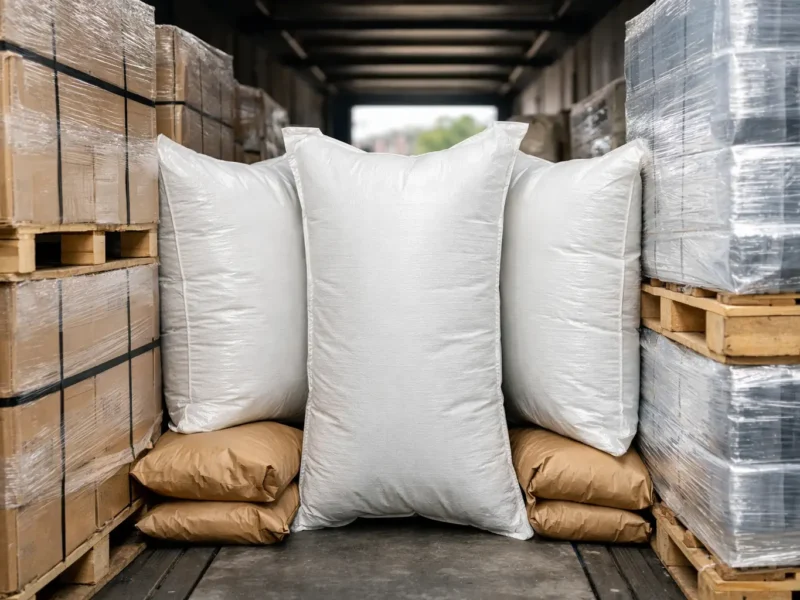
A few inches of open space between railcar loads can become a costly problem after miles of track movement, coupling impacts, vibration, and braking. The best railcar void fillers do more than occupy that space. They distribute force between stable load faces, limit lateral movement, and help prevent the crushed corners, shifted pallets, and rejected product that turn a rail shipment into a claim.
For many shippers, dunnage air bags are the most efficient answer. But a bag is only as effective as its material, size, placement, inflation level, and the condition of the loads it contacts. Railcar securement is not a place for one-size-fits-all purchasing. The correct void-filling system depends on the cargo, the void, the railcar configuration, and the forces the shipment will face.
What Makes a Railcar Void Filler Effective?
Railcars create a demanding cargo environment. Freight can experience extended transit times, repeated vibration, switching impacts, and force from starts and stops. A void filler must maintain its position and provide consistent pressure without damaging the load itself.
An effective filler conforms to the available space while spreading contact pressure across a broad area. This is where properly sized dunnage bags perform well. Inflated between stable load units, they fill irregular gaps more completely than loose material and can be installed with less labor than many rigid bracing methods.
The key word is stable. Air bags are designed to restrain lateral movement between loads that are already appropriately unitized and supported. They do not correct weak pallet patterns, broken cartons, unstable stacks, or inadequate floor securement. They also do not replace blocking, bracing, tiedowns, or other securement methods where those methods are required by the shipment plan.
Dunnage Air Bags: Often the Best Railcar Void Fillers
For palletized and industrial freight, dunnage air bags are often the best railcar void fillers because they combine high void coverage with fast application. A bag can be positioned in the gap, inflated with the correct equipment, and adjusted to fit the cargo profile. Once properly installed, it helps keep adjacent load faces from shifting toward one another.
The right bag construction matters. Rail shipments generally call for durable materials selected for the load weight, exposure, route conditions, and required performance level. Common options include PP woven bags, kraft paper bags, and PE air bags. Each has a valid role, but they are not interchangeable.
PP woven dunnage bags for demanding loads
PP woven dunnage bags are a strong choice for many railcar applications involving dense palletized goods, industrial components, packaged building materials, and other loads that need dependable lateral restraint. Their woven exterior is designed for durability, while the internal liner retains air pressure.
These bags are particularly useful when a shipper needs a reusable-style performance profile and a material that can tolerate the normal abrasion and pressure associated with demanding freight environments. Bag selection should still account for the load edges and contact surface. Sharp corners, protruding hardware, or damaged pallet boards can puncture any inflatable product without proper protective measures.
Kraft dunnage bags for clean, consistent voids
Kraft dunnage bags remain a practical option for shipments with relatively smooth, predictable load faces and properly prepared voids. They can provide an economical solution where load conditions support their use and where the shipment does not call for the higher abrasion resistance of woven material.
The trade-off is straightforward: cost should be evaluated against route severity, cargo value, and damage exposure. A lower-cost bag is not a savings if it is underspecified for the shipment and fails during transit. For rail, where a load may be exposed to extended handling and significant movement, selecting the bag based on actual conditions is more important than selecting solely by unit price.
PE airbags for lighter-duty applications
PE airbags can be suitable for lighter-duty void filling and applications with controlled load conditions. Their advantages can include easy handling and material efficiency. They are not typically the first choice for high-force railcar applications with heavy, rough, or irregular cargo faces.
If the shipment involves heavy pallets, long transit distance, repeated rail handling, or high-value industrial goods, a more durable bag construction may be the better operational decision. The filler must match the risk, not just the gap.
Size the Bag to the Void, Not the Railcar
One of the most common void-filling mistakes is ordering a bag based on a general railcar category rather than measuring the actual cargo gap. The usable void can change with pallet dimensions, load pattern, carton overhang, slip sheets, and the location of the gap in the car.
A dunnage bag should be wide enough to make broad, centered contact with both load faces after inflation. It should be long enough to cover a meaningful portion of the load height without extending into areas where it can fold, pinch, or contact an unstable surface. A bag that is too narrow can concentrate pressure. A bag that is too small may not control movement. A bag that is oversized for the void may be difficult to position correctly and more likely to be damaged.
Measure the void at the intended installation point, including the minimum and maximum gap if the load faces are uneven. Then consider the height and width of the contact area, not only the distance between loads. This information gives a supplier the basis to recommend an appropriate bag size and performance level.
Load Condition Determines the Securement Plan
Dunnage bags work best when they contact firm, generally parallel surfaces. Unitized pallet loads with stable outer faces are usually good candidates. Loads with deep recesses, exposed coils, sharp metal edges, loose bags, or heavily irregular profiles may require additional protection or a different securement approach.
Before filling a void, inspect the cargo for crushed cartons, damaged stretch wrap, weak pallet decks, and protrusions. Correct those problems before the railcar is released. Inflating a bag against an unstable load can transfer pressure to the weakest area and make a minor problem worse.
In some cases, corrugated pads, protective boards, or other load-face protection can help distribute contact pressure and protect the bag from abrasion. These components should support the securement plan, not become improvised substitutes for a properly rated void filler.
Inflation Equipment Is Part of the System
A quality dunnage bag needs the correct valve and inflator tool. Improper inflation can leave the bag underfilled and ineffective, or overpressurized and exposed to unnecessary stress. Use inflation equipment designed for the bag valve and follow the bag manufacturer’s pressure guidance for the specific application.
Shop air can be used with the proper inflator setup, but speed is not the objective. Controlled inflation is. The operator should observe how the bag expands, confirm full contact on both load faces, and stop before the bag is forced into a distorted shape. A correctly installed bag should be centered in the void, upright as intended, and supported by solid cargo surfaces.
Do not use a dunnage bag as a lifting device, a spacer for unsupported freight, or a way to force loads into alignment. Its job is to fill space and help restrain movement after the load has been properly positioned.
Questions to Answer Before Ordering
A productive railcar void-filler recommendation starts with shipment facts, not a catalog number. Procurement and shipping teams should be ready to provide the cargo type, unit weight, pallet or package dimensions, void width, contact height, railcar type, and expected transit conditions. The team should also identify whether the bags will contact smooth corrugate, wood, plastic, metal, or another surface.
It is also useful to consider whether the shipment is a recurring lane or an occasional movement. A repeat rail program benefits from standardized bag sizes, approved work instructions, compatible inflators, and operator training. That consistency reduces installation variation and makes it easier to control material usage and damage performance over time.
For unusual freight, photos and a simple load diagram can prevent an expensive mismatch. A technical recommendation based on the actual void and cargo geometry is more valuable than a generic statement that a bag is suitable for rail.
Choose for Performance, Then Control the Process
The best result comes from pairing the correct bag with a repeatable loading process. Train operators to inspect the load, place the bag at the right elevation, protect vulnerable contact areas, use the proper inflator, and verify the final installation before the railcar is closed. Documenting the configuration is especially worthwhile for high-value cargo and recurring lanes.
Plastix USA can help shippers match dunnage bag material, dimensions, valves, and inflation tools to the actual railcar application. A correctly selected void filler is a small part of the shipment by cost, but it can protect a much larger investment in product, labor, customer service, and claim prevention.
When railcar loads move without room to build momentum, cargo arrives in better condition. Start with the measured void, the real load condition, and a filler built for the work.