
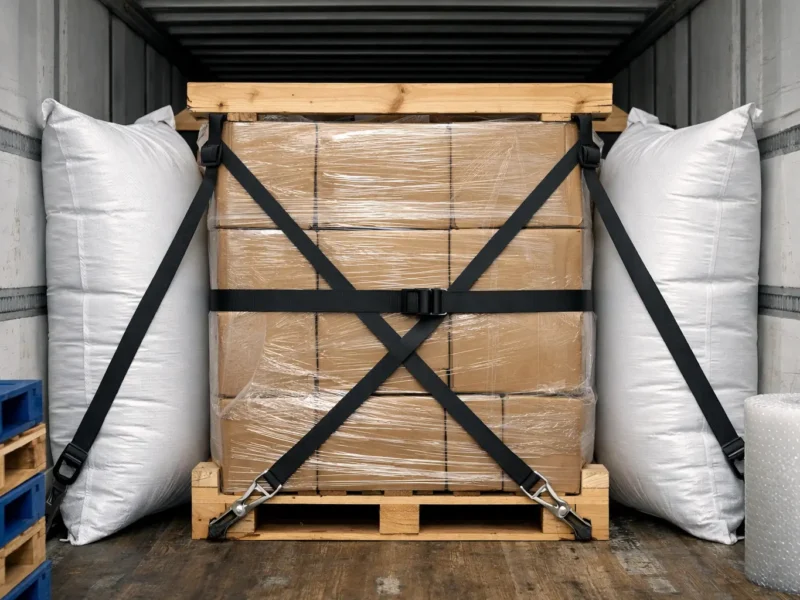
A pallet can be stretch-wrapped, stacked square, and loaded tightly at the dock, then still arrive damaged because it had room to move. Knowing how to brace palletized freight means planning for the forces created by braking, acceleration, turns, rail impact, and repeated handling. The goal is not simply to fill open space. It is to keep the load stable without crushing cartons, puncturing packaging, or transferring force into an unsupported pallet.
For shippers, the right bracing plan reduces product damage, rejected deliveries, freight claims, and avoidable rework. It also gives warehouse teams a repeatable loading process instead of asking them to improvise after the trailer doors are open.
Start With the Load, Not the Empty Space
Effective freight bracing begins before the trailer is loaded. Review the pallet footprint, gross weight, stack height, case strength, and the condition of the pallet itself. A stable unit load is the foundation. Bracing cannot correct a pallet that is overhung, poorly wrapped, leaning, or built on broken deck boards.
Look at how the freight behaves as a group. Rigid palletized goods such as bagged material, drums on pallets, and tightly unitized industrial products can often transfer restraint through the load face. Fragile corrugated cases, irregular packs, and light pallets need more care. Applying concentrated pressure to weak cartons can create damage even when the shipment does not shift.
Transport mode matters as well. A short, dedicated truck route may expose the load to fewer handling events than an intermodal shipment. Rail and intermodal moves can involve longer transit times and repeated impacts. Heavier loads, greater voids, and more demanding routes generally require a more deliberate securement design.
Build a Stable Load Pattern First
Load pallets squarely and distribute weight as evenly as practical. Place heavier, more stable freight on the floor and avoid creating tall, narrow towers that are prone to tipping. If mixed pallet heights are unavoidable, avoid placing a short pallet where it cannot support the face of a taller adjacent load.
Whenever possible, load palletized freight in a tight pattern that limits longitudinal and lateral movement. The best bracing systems support a sound load arrangement. They do not replace it.
Keep the load face reasonably even. Large gaps between individual pallets can allow the first row to gain momentum before it contacts the bracing material. That momentum can damage both the product and the restraint system. If the shipment includes several pallet types, group compatible heights and weights together rather than alternating heavy and light units across the trailer.
Before adding restraints, confirm that pallets are not overhanging into the trailer aisle and that forks will not snag loose wrap or exposed bracing materials at unloading. Good securement must work at both ends of the trip.
Choose the Right Method to Brace Palletized Freight
The proper method depends on the direction of movement you need to control. Forward and rearward movement is common during braking and acceleration. Side-to-side movement can occur in turns, during rail handling, or when freight does not fully occupy the trailer width.
Blocking and bracing materials can work together, but each has a different job:
- Load bars and decking beams help restrain palletized freight at the rear of a load or create a physical barrier between sections. Use equipment rated for the application and positioned against structurally sound contact points.
- Wood blocking or engineered blocking can secure heavy, dense loads when it is properly installed and compatible with the vehicle and customer requirements. It is often useful where a fixed physical stop is needed.
- Dunnage air bags fill lateral or longitudinal voids between stable load faces, or between freight and a suitable trailer wall. When correctly sized and inflated, they distribute pressure over a broad area and help prevent load shift.
- Void fillers, pads, and edge protection protect cartons and help create a more uniform contact surface. They are especially useful when pallet faces are uneven or packaging is vulnerable to abrasion.
Do not treat these options as interchangeable. A dunnage air bag is designed to fill a void and stabilize a load. It is not a substitute for a rated restraint where the load needs a hard mechanical barrier. Likewise, a load bar across the rear of a trailer may not solve side-to-side movement in an open center gap.
Use Dunnage Bags Correctly
Dunnage air bags are a practical choice for many palletized freight applications because they can conform to the void and apply broad, controlled pressure. The bag must match the void dimensions, load weight, transport mode, and required level of protection.
Select a bag that fits the gap. An undersized bag may overexpand and place stress on its seams or fail to make adequate contact. An oversized bag may fold, wrinkle, or inflate unevenly. In general, the bag should fill the available void without being forced around obstructions or into a shape it was not designed to hold.
Place the bag against broad, stable load surfaces. Do not inflate it against sharp pallet corners, exposed nails, damaged cartons, or unprotected edges. Use a corrugated protector, plywood panel, or other suitable load-protection material when needed to spread contact pressure and reduce puncture risk.
Inflate with the correct tool and follow the bag manufacturer’s pressure guidance. Overinflation can damage freight and reduce bag performance. Underinflation leaves the void partially open and allows the load to build momentum. After inflation, inspect the installation from both sides if access allows. The bag should be centered, supported, and in consistent contact with the load faces.
For long or demanding shipments, do not assume one bag solves every gap. Multiple voids may need separate treatment, particularly when there are changes in pallet height, product density, or load geometry. A bag placed high on a tall load will not stabilize movement occurring at the pallet base.
Protect Against Forward, Rearward, and Lateral Shift
A complete bracing plan addresses the actual direction of risk. Rear-door restraints are commonly used to help prevent freight from moving backward during transit or when doors are opened. However, they should not be the only consideration.
If pallets can move forward under hard braking, use a loading pattern and approved restraint method that controls forward travel. If there are gaps along the trailer walls or between pallet rows, use appropriate side bracing. If the trailer is only partially loaded, the open space may be large enough that a different load plan, additional blocking, or a combination of restraints is required.
Consider vertical movement, too. Tall loads can sway, and stacked pallets can shift when the bottom unit is not stable. Use stackable pallets only when the product, pallet design, wrapping method, and route conditions support it. Never depend on stretch wrap alone to hold a high, heavy stack together under transport forces.
Inspect the Trailer and the Securement Plan
The trailer condition affects bracing performance. Inspect walls, floor condition, logistics posts, load locks, and anchor points before loading. A damaged wall or compromised anchor point should not be used as a reliable restraint surface.
Check for protrusions, moisture, debris, and sharp edges that can damage packaging or dunnage bags. Verify interior dimensions rather than relying on a standard trailer measurement. Small differences in trailer width, wall construction, and load layout can change the void size enough to affect bag selection.
Document the load pattern when it is repeated regularly. A simple loading diagram showing pallet positions, void locations, restraint types, and bag sizes helps warehouse teams build the same secure load every time. It also makes training easier when staffing changes or a new carrier is used.
Avoid the Most Common Bracing Failures
Most freight-bracing problems come from using the right product in the wrong application or skipping the inspection step. Avoid placing dunnage bags against weak or damaged packaging, using a bag that is too small for the void, or inflating bags without edge protection where puncture risk exists.
Do not brace only the last row while leaving large internal gaps farther forward. Avoid mixing unstable and rigid pallets in a way that lets the heavier product push into the lighter one. And do not assume a tightly wrapped pallet is automatically a secured pallet. Unitization and vehicle securement are related, but they are not the same thing.
For recurring shipments, track where damage occurs. If claims consistently involve crushed corner cartons, the answer may be better load-face protection. If pallets arrive displaced, evaluate void size, bag placement, and whether the bracing is controlling the correct direction of movement.
A dependable freight-bracing program is built on repeatable decisions: stable pallets, sensible load patterns, correctly rated restraints, and void-fill products matched to the shipment. When the load, trailer, and route create uncertainty, Plastix USA can help evaluate bag type, size, and inflation equipment before a preventable damage claim becomes part of the shipping process.