
A load that leaves the dock looking stable can still arrive shifted, crushed, or rejected if the securement method does not match the freight, void size, and transit mode. The best cargo securement methods are not universal. They depend on how the product moves, where force is applied, and how much movement the load can tolerate before damage starts.
For warehouse managers, packaging engineers, and freight teams, that distinction matters. A method that performs well in over-the-road trucking may not be enough for railcar impact. A low-cost material may look acceptable at loading, then fail under repeated vibration, braking, or side-to-side movement. Good securement is less about using more material and more about using the right combination of restraint, bracing, and void control.
What makes cargo securement effective
Effective cargo securement does two jobs at once. It limits movement during normal transit conditions, and it keeps that movement from turning into product damage when conditions get rough. That means controlling forward shift, lateral movement, and vertical bounce without creating new problems such as crushed packaging, unstable pallet stacks, or difficult unloading.
The most reliable approach starts with the load itself. Unitized freight with strong packaging gives you more securement options than irregular or fragile product. Pallet condition, stack pattern, weight distribution, and trailer or container condition all affect performance. Securement methods should be selected around those realities, not assumed after the load is already built.
Best cargo securement methods by application
Dunnage air bags for void fill and load stabilization
Dunnage air bags are one of the best cargo securement methods when the primary risk is load shift caused by open voids between pallets or freight units. When properly sized and inflated, they fill space between loads and apply consistent pressure that helps keep freight in place during transit.
This method is especially effective in truck, railcar, and intermodal shipments where side-to-side or front-to-back movement develops over time. It is also efficient at the dock. Teams can secure loads quickly without building custom wood bracing for every shipment.
That said, air bags are not a catch-all solution. They must match the void size, load weight, and mode of transport. Underinflation reduces holding force. Overinflation can damage cartons or create instability. Bag construction matters too. For heavier or more demanding applications, material strength and valve reliability are not details – they are performance factors.
Blocking and bracing for heavy or irregular freight
Blocking and bracing remain a strong option for dense, heavy, or non-uniform cargo that needs physical restraint rather than just gap filling. Wood, metal, or other rigid materials can be positioned to resist movement and keep machinery, large industrial components, or awkward freight from shifting under force.
This method is common in flatbeds, railcars, and certain container loads where the cargo shape limits the use of standard packaging. It provides direct resistance and can be highly effective when engineered correctly.
The trade-off is labor and consistency. Blocking and bracing usually takes more time, can require custom cuts or placement, and depends heavily on the crew following the correct pattern. If the bracing is poorly installed or the contact points are weak, the system may fail before the load reaches its destination.
Tie-downs and straps for direct restraint
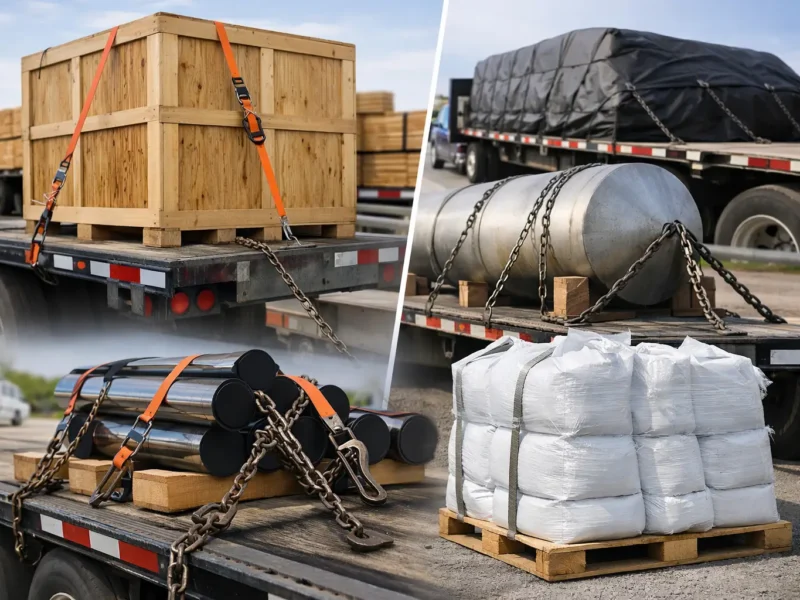
Straps are widely used because they provide direct restraint and work across many cargo types. They are often one of the best cargo securement methods for palletized loads, equipment, bundled materials, and mixed freight where the goal is to keep product anchored to the trailer, platform, or container floor.
The key is matching strap strength, tension, and anchor points to the actual load forces. A strap is only as reliable as the edge protection, anchor integrity, and load geometry around it. Sharp edges can cut webbing. Poorly distributed tension can crush packaging or allow one side of the load to loosen.
Straps are practical and versatile, but they are not ideal for every void or every stack pattern. If freight can still shift inside the unitized load, external tie-downs may not solve the internal movement problem.
Load bars and decking beams for sectional control
Load bars and decking beams are useful when freight needs to be segmented or supported within a trailer. They help prevent cargo from rolling or sliding into adjacent product and can create separate loading zones for mixed shipments.
This is often a smart method for LTL, route distribution, or partial truckloads where multiple stops increase handling risk. Instead of relying only on the rear section to hold everything in place, bars can control movement within the body of the trailer.
Their limitation is obvious. They work best with compatible trailer interiors and relatively predictable load dimensions. They are not a replacement for proper pallet stability or void management. In many cases, they perform best as part of a combined securement plan.
Stretch wrap and shrink wrap for unitization
Wrapping is one of the most common tools in freight handling, and for good reason. It turns multiple cartons or products into a more stable unit, helps maintain pallet integrity, and reduces minor shifting during loading and unloading.
But wrap is often overestimated. It is useful for unitizing a pallet, not for replacing true cargo securement in transit. If a heavy load has open voids between pallets or is exposed to repeated impact, wrap alone will not provide enough resistance.
Film selection, wrap pattern, containment force, and pallet quality all affect performance. For light to moderate pallet loads, good wrapping can be a solid first layer of control. For demanding lanes or heavier products, it usually needs to be paired with another securement method.
Anti-slip materials for friction control
Anti-slip mats and friction-enhancing materials help reduce cargo movement by increasing resistance between the load and the deck or between stacked layers. They are especially useful when vibration is a concern or when pallets tend to walk during transit.
This can be a cost-effective addition to a broader securement system. In some applications, a simple friction layer improves the performance of straps or bracing enough to reduce the amount of additional material needed.
Still, friction control has limits. It supports securement; it does not replace it. If the load is top-heavy, poorly stacked, or exposed to major impact, anti-slip materials alone will not hold it in place.
Corner boards, edge protectors, and protective fillers
Support components do not always get enough attention, but they matter. Corner boards, edge protectors, and protective fillers help distribute pressure, protect cartons, and improve the performance of straps and wrap. Without them, securement materials can cut into packaging or lose tension as the load settles.
These are not usually standalone methods, but they can make the difference between a secure load and a damaged one. For shippers dealing with crush-sensitive packaging or high-value goods, these support materials often pay for themselves by preventing load deformation during transit.
How to choose the best cargo securement methods
The right method starts with five questions. What does the product weigh? How much empty space exists between units? What mode is carrying the load? How fragile is the packaging? And what kind of movement is most likely on that lane?
Truckload freight usually deals with braking, turning, and road vibration. Rail adds stronger impact forces and repeated coupling shocks. Intermodal combines multiple handling environments, which means a method that is barely adequate in one leg can fail across the full trip.
That is why securement selection should be application-specific. Heavy paper rolls, bagged goods, palletized food products, industrial parts, and consumer packaged freight do not behave the same way in transit. The lowest unit cost is not always the lowest shipping cost if claims, reloads, and rejected product are part of the equation.
For many shippers, the most effective setup is a layered one. Unitize the product correctly, eliminate critical voids, apply direct restraint where needed, and protect load edges so the securement system keeps working after miles of vibration. Suppliers that understand dunnage selection, inflation tools, and transport mode differences can help remove the guesswork. That is where experienced manufacturers such as Plastix USA can add practical value beyond simply shipping material.
The right securement method should make the load safer, the dock faster, and the result more predictable. If a method looks cheap but creates uncertainty, it is probably costing more than it saves. Start with the load conditions, match the materials to the risk, and build a securement process your team can repeat with confidence.