
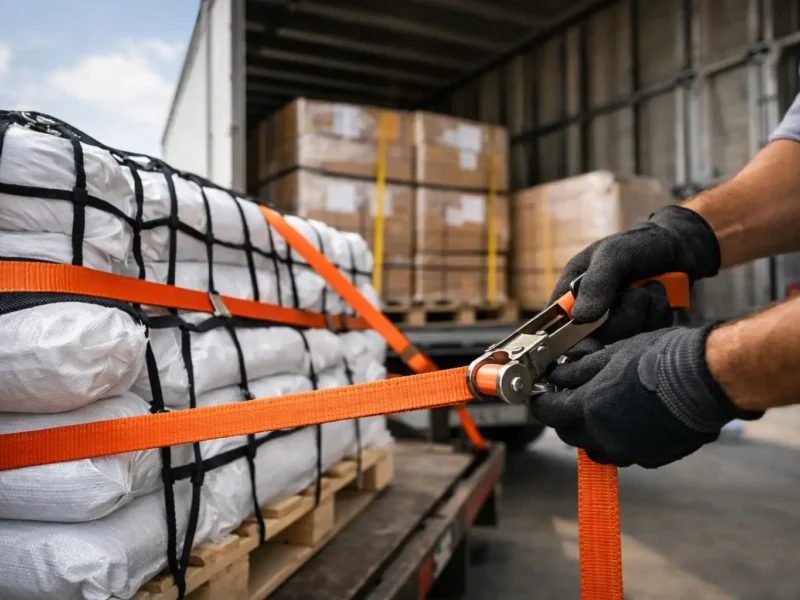
A load does not have to tip over to become expensive. Most freight damage starts with a few inches of movement – enough to crush corners, break bands, deform cartons, or turn good inventory into a claim. If you are figuring out how to secure freight loads, the real job is controlling movement before the trailer, railcar, or container ever leaves the dock.
How to secure freight loads starts with movement control
Freight securement is not one decision. It is a system built around the product, the void space, the mode of transport, and the forces the shipment will face in transit. A palletized food load moving by truck needs a different approach than steel components moving by railcar. Intermodal adds another layer because the shipment is exposed to repeated handling and variable impact conditions.
That is why the best securement plans start with one question: where can this load move? Forward movement under braking, lateral movement in turns, and vertical vibration over long miles all matter. Once you identify the direction of risk, you can choose the right combination of load placement, friction, blocking, bracing, and void-fill solutions.
Too many damage problems come from treating all empty space the same. A narrow side gap between stable pallets is not the same as a wide void between heavy, rigid units. The first may need modest restraint. The second may need a properly rated dunnage air bag supported by sound load geometry and correct inflation.
Start with the freight itself
Before selecting any securement product, look closely at what you are shipping. Weight distribution matters as much as total weight. Dense products with a high center of gravity behave differently than lighter, wide-based loads. Unitization matters too. Stretch-wrapped pallets, banded bundles, corrugated cartons, drums, and irregular industrial parts each respond differently to pressure and vibration.
The packaging has to withstand the securement method. If the product is fragile or the outer packaging is weak, aggressive pressure can cause as much damage as load shifting. That is where a more deliberate setup helps. Sometimes the right answer is a stronger pallet pattern, corner protection, or slip-resistant interface. Other times it is better void management between loads so pressure is applied evenly rather than concentrated on one weak panel.
Transport mode changes the calculation. Truckload shipments often deal with braking and road vibration. Rail shipments can see higher impact forces during coupling and switching. Intermodal can combine long dwell times, repeated transfers, and mixed handling conditions. There is no single securement formula that fits all three.
The basics that still matter
Good freight securement is not always complicated. It usually starts with disciplined loading.
The load should be placed to support trailer or container balance, with weight distributed according to equipment limits and carrier requirements. Pallets should sit square and stable. Overhang, leaning stacks, damaged skids, and uneven deck contact create problems that no air bag or brace can fully correct.
Void space should be minimized where possible through load planning. The larger the gap, the more room the freight has to build momentum before contacting another unit or the wall. That momentum is where damage escalates quickly. If the load plan leaves significant voids, those spaces should be addressed with the proper securement method instead of being ignored and hoped away.
Blocking and bracing still have a clear role, especially with heavier or irregular shipments. Wood blocking, corrugated fillers, friction mats, and other mechanical restraints can work well when matched to the application. But they are not interchangeable. A method that performs well for one commodity may be inefficient, inconsistent, or too labor-intensive for another.
Dunnage bags solve the right problem when used correctly
For many palletized and unitized loads, dunnage air bags are one of the most efficient ways to control lateral and longitudinal movement in transit. They are designed to fill voids between cargo units and apply distributed pressure that keeps the load stable. That pressure matters because it turns empty space into controlled contact.
The advantage is speed and consistency. A properly selected bag can secure voids quickly, reduce the need for heavier bracing materials, and support higher throughput on the dock. For operations trying to reduce damage without slowing shipments, that matters.
But dunnage bags are not magic. They work best when the load faces are reasonably even, the void size is within the bag’s intended range, and the product can tolerate the applied pressure. If the gap is too large, the surfaces are too irregular, or the freight is too sharp or unstable, another method or a combined method may be needed.
Bag construction also matters. Polywoven, kraft, and polyethylene styles each fit different operating conditions and buyer priorities. Valve quality, inflation control, and burst performance are not small details. In industrial shipping, consistency is the difference between a system you can trust and one that creates new variability.
How to secure freight loads with the right dunnage bag setup
Using a dunnage bag effectively starts with sizing. The bag must match the void width, load height, and transport mode. An undersized bag will not create enough contact area. An oversized bag can fold poorly, inflate unevenly, or apply force where the packaging cannot handle it.
Placement is just as important. The bag needs to sit in the correct void, centered where it can make broad contact with both load faces. If it is twisted, pinched, or positioned against a weak edge, performance drops. Inflation should follow the manufacturer’s guidance for that bag type and application. Overinflation can damage cargo or the bag. Underinflation leaves movement in the system.
The surrounding load has to be sound. Dunnage bags do not fix poor pallet quality, unstable stacking, or major misalignment. They perform best as part of a secure load pattern, not as a patch for one.
For rail and intermodal, the required performance level may be higher than for over-the-road truck shipments. That is where product selection and testing become especially important. Buyers should know whether the bag format and level are appropriate for the mode, load weight, and void conditions. If there is any uncertainty, it is better to get an application-specific recommendation than rely on guesswork.
Common mistakes that lead to freight claims
Most securement failures are predictable. The load was not evaluated correctly, the wrong method was used, or the crew was asked to work too fast without a clear standard.
One common mistake is choosing securement by habit instead of by load condition. A warehouse may use the same bag size, inflation pressure, or bracing method for every shipment because it is familiar. That works until the freight changes. Another issue is ignoring packaging strength. If the carton wall or unitized load cannot resist the pressure applied during transit, movement or crush damage follows.
Training gaps also show up quickly. Even a quality dunnage bag will underperform if it is placed badly or inflated with the wrong tool setup. The same goes for wood bracing installed without enough contact or without regard to force direction.
Then there is the purchasing mistake: buying strictly on piece price. Lower-cost securement materials can become expensive fast if they create inconsistency, slow loading, or increase damage claims. For most shippers, the true cost is not the bag, board, or strap. It is the rejected shipment, the replacement order, the customer complaint, and the time spent cleaning up preventable problems.
Build a repeatable securement standard
The companies that reduce freight damage most consistently do not rely on individual judgment alone. They create a repeatable standard for each major load type. That includes documented void ranges, approved bag or bracing specifications, inflation guidance, and simple inspection checks before release.
That level of standardization helps procurement, warehouse operations, and quality teams work from the same playbook. It also makes training easier and reduces variation across shifts and facilities. If your shipping profile includes multiple commodities or transport modes, it makes sense to segment standards by product family instead of forcing one method across everything.
This is where a supplier with actual application knowledge adds value. Plastix USA works with shippers that need more than a generic product list. The right recommendation depends on load weight, void size, transit mode, and handling conditions – and those details matter when the goal is fewer claims and more predictable performance.
The most practical approach is to review your highest-risk lanes first. Look at damage trends, mode-specific issues, and load patterns that create recurring voids. Then tighten the method, train to it, and measure results. Freight securement improves fastest when it is treated as an operating discipline rather than a last-minute dock task.
Every shipment carries some level of motion. The job is not to eliminate motion completely. It is to control it well enough that the cargo arrives in the same condition it left.