
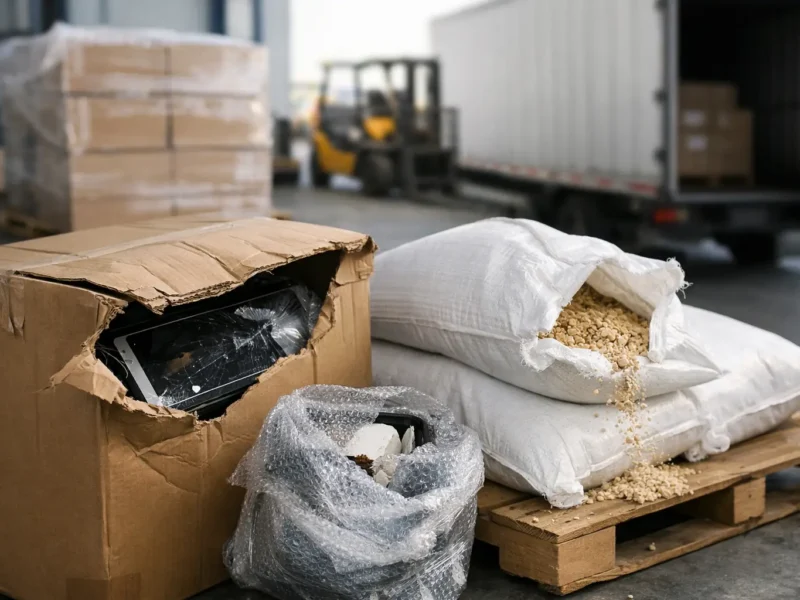
A damaged load rarely starts with the impact you see at delivery. In most cases, shipping damage root causes show up much earlier – when the freight is packed, unitized, loaded, braced, or handed off between modes. By the time a consignee finds crushed cartons, broken product, or shifted pallets, the actual failure has already happened somewhere upstream.
For warehouse managers, packaging engineers, and freight teams, that distinction matters. If you treat damage as a one-off handling problem, you keep fixing symptoms. If you isolate the root cause, you reduce claims, protect sellable inventory, and improve consistency across truck, rail, and intermodal shipments.
Why shipping damage root causes are often misdiagnosed
Damage is easy to see. The reason behind it is not. A torn carton may look like rough handling, but the real issue may have been too much void space between loads. A collapsed pallet stack may be blamed on stacking strength, when the load actually shifted because it was never properly stabilized for transit forces.
This is where many operations lose money. Teams review photos after delivery, identify the visible failure, and move on. But freight damage usually comes from a chain of small decisions rather than a single dramatic event. Packaging selection, pallet quality, trailer condition, inflation method, load pattern, and mode of transport all affect the outcome.
The practical lesson is simple: if your corrective action does not address movement, compression, vibration, or unsupported gaps, the same claim will return.
The most common shipping damage root causes
Load shift inside the trailer, container, or railcar
Load shift is one of the most frequent sources of in-transit damage. Freight does not need a major accident to move. Normal braking, cornering, coupling impacts, lane changes, road vibration, and rail slack action all create force. If product has room to travel, it usually will.
Once movement starts, damage compounds quickly. Pallets lean into each other, cartons deform, bands loosen, and edges take concentrated pressure they were not designed to absorb. In mixed loads, stronger products can crush weaker ones. In high-value freight, even minor shifting can create cosmetic damage that makes the inventory unsellable.
Void management is a major factor here. Empty space between load faces invites movement. The right dunnage solution depends on void size, load weight, transport mode, and the surface area in contact with the cargo. An under-spec bag, poor placement, or incomplete inflation can leave the load effectively unsecured.
Inadequate packaging design
Primary packaging may protect the product, but transit packaging has a different job. It must hold up under compression, vibration, and repeated handling through the full route. That is where many designs fall short.
A box can pass an internal pack-out review and still fail in actual freight conditions. Board grade may be too light. Corner support may be missing. Inner protection may not keep heavy parts from migrating inside the carton. Stretch wrap may hold the top layer but do little for horizontal stability.
This is especially common when packaging is designed around storage rather than transport. A pallet that sits safely in a warehouse may not survive a long truck route or an intermodal transfer. The better approach is to evaluate packaging against actual shipping conditions, not ideal ones.
Weak palletization and poor unit load integrity
A stable pallet is more than stacked boxes with stretch film around them. Unit load integrity depends on pallet condition, stack pattern, weight distribution, wrap force, containment, and how well the load behaves when lateral force is applied.
If the pallet deck is damaged, the load may flex during forklift handling. If heavy product is placed high, the center of gravity works against stability. If cartons are column-stacked without enough support, vertical compression can cause collapse. If wrap tension is inconsistent, the load may look secure at shipping and loosen before delivery.
Many recurring claims come back to the same issue: the palletized load was never strong enough to act as one unit.
Improper securement for the transport mode
Truck, rail, and intermodal shipping do not produce the same hazards. A securement method that performs adequately in over-the-road trucking may not be sufficient in a railcar. Rail shipments often involve harsher longitudinal force. Intermodal adds more touchpoints and more opportunities for movement and handling variation.
This is one reason generic securement decisions create avoidable risk. If a load is heavy, has smooth contact surfaces, or will move through rail or containerized channels, securement needs to be matched to those conditions. The right bag level, material construction, and inflation practice matter. So does valve quality and whether the inflation tool delivers consistent fill pressure.
When mode-specific risk is ignored, damage is often blamed on carriers when the securement plan was never built for the trip.
Forklift and dock handling errors
Not all damage happens on the road. A significant share starts in the warehouse or at transfer points. Forklift tines can puncture product or pallets. Loads can be pushed rather than lifted cleanly. Pallets can be staged unevenly, struck at corners, or loaded with existing tilt. At the dock, rushed teams may place freight too tightly in one area and leave avoidable gaps in another.
Handling damage can be hard to separate from transit damage because the signs overlap. A split pallet stringer, dented lower cartons, or punctured sidewall may later worsen in transit and appear to be a carrier issue. In reality, the root cause was introduced before the trailer doors were closed.
Moisture, temperature, and environmental exposure
Freight damage is not always impact-related. Moisture can weaken corrugated packaging, promote mold, stain finished goods, and reduce stacking strength. Temperature swings can affect adhesives, films, seals, and certain product materials. Condensation inside containers can create hidden damage that is only discovered at receipt.
These risks are often underestimated because the load looked fine when it shipped. But environmental exposure changes package performance over time. A carton with marginal compression strength becomes much more vulnerable after absorbing moisture. A wrapped pallet may trap condensation if the materials and route are not considered together.
Quality variation in packaging and securement materials
Consistency matters. Even a sound load plan can fail if the materials used to execute it vary from batch to batch. Pallets with uneven dimensions, stretch film with poor gauge control, low-quality valves, or bags that do not perform to expected standards all introduce risk.
This is where procurement decisions can quietly increase claims. Lower upfront price does not help if material performance is inconsistent. For dunnage air bags in particular, manufacturing quality, testing discipline, and reliable material inputs affect how the bag inflates, holds pressure, and supports the load during transit.
For operations that ship repeatedly, quality variation is not a minor issue. It creates unstable outcomes, which makes damage harder to predict and harder to fix.
How to identify the real root cause
The best investigations start before assigning blame. Look at the load pattern, void size, pallet condition, packaging spec, transport mode, and where the damage appears on the freight. Sidewall crush, top-load collapse, corner abrasion, and lower-level puncture each point to different failure modes.
It also helps to compare damaged shipments against successful ones. If the same product arrives intact by truck but not by rail, mode-specific securement may be the issue. If failures appear only on heavier pallets, compression or pallet quality may be driving the problem. If damage spikes after a packaging change or supplier change, material performance should be reviewed immediately.
Photos alone are rarely enough. Useful root-cause work includes shipment history, packaging specs, trailer or railcar conditions, and the exact securement method used. Small details matter, including bag size, placement, inflation pressure, and whether the load had direct support where force was expected.
Reducing damage means controlling movement
Most freight damage comes back to the same physical reality: cargo moved, flexed, compressed, or rubbed in a way the packaging system could not withstand. That means prevention is usually less about adding more material and more about applying the right material in the right way.
Sometimes the fix is stronger packaging. Sometimes it is better pallet build quality. Often it is improved void fill and load bracing so the freight cannot build momentum in the first place. For many industrial shipments, properly specified dunnage air bags are part of that solution because they help stabilize loads, limit lateral and longitudinal movement, and make better use of trailer or container space when selected correctly.
The trade-off is that no single securement setup fits every shipment. Lightweight boxed product, heavy industrial components, palletized consumer goods, and mixed freight all behave differently. The correct answer depends on load weight, gap size, surface contact, and mode of transit. That is why experienced review matters more than generic rules.
Plastix USA works with shippers that need that kind of practical fit between product and application, especially where repeated load shift creates preventable claims.
If damage keeps showing up in the same lanes, on the same SKUs, or with the same load pattern, assume the issue is systemic until proven otherwise. The fastest savings usually come from fixing the condition that allows movement, not from arguing over the damage after delivery.