
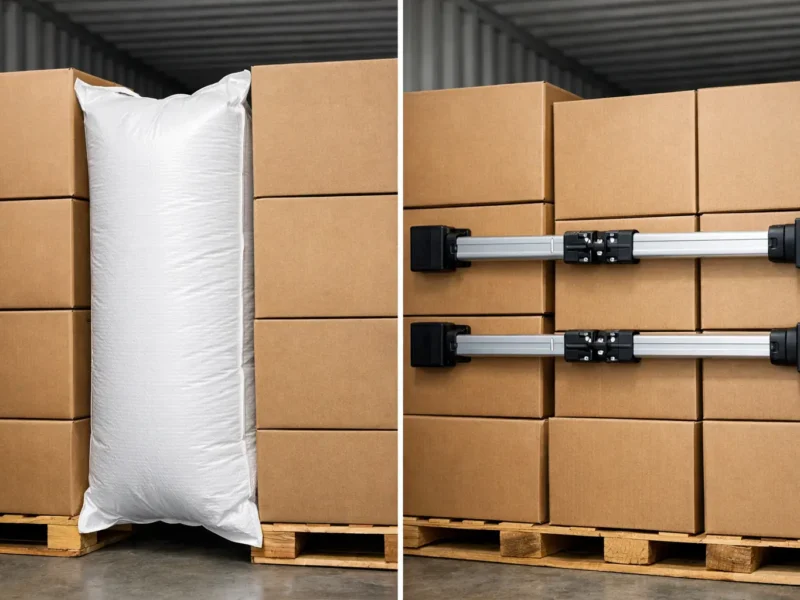
A shifted load usually gets blamed on the trailer, the driver, or the road. More often, the real problem started before the doors closed. When shippers compare dunnage bags vs load bars, the right answer is rarely about which tool is better in general. It is about which one matches the freight, the void, the mode of transport, and the amount of force the load will see in transit.
Both products are used to control movement. Both can reduce cargo damage when they are selected and applied correctly. But they work in very different ways, and the trade-offs matter if you are shipping palletized goods, paper products, drums, appliances, food loads, or industrial materials by truck, railcar, or intermodal container.
Dunnage bags vs load bars: the core difference
Dunnage bags fill empty space between cargo units. Once inflated, they create lateral pressure that helps stabilize the load and limit side-to-side shifting. They are commonly used in truck, rail, and intermodal shipments where there is a measurable void between product stacks, pallets, or unitized freight.
Load bars do not fill the void. They brace cargo by spanning across the trailer or container wall to wall. Their job is to create a physical barrier that keeps freight from moving forward, backward, or in some cases from tipping into open space.
That difference sounds simple, but it changes everything. If your load has uneven surfaces, variable pallet heights, or broad empty gaps between units, dunnage bags are often the more effective tool. If you need a fast restraint near the trailer door, or you are separating load zones inside a dry van, load bars can be the better fit.
Where dunnage bags perform best
Dunnage bags are at their best when the load can support compression and the void can be filled correctly. They are especially useful for palletized freight with consistent faces, stacked materials, corrugated cases, bagged goods, and many industrial loads that move in groups rather than as single heavy pieces.
In truckload shipping, a dunnage bag helps distribute force across a larger contact area than a single point restraint. That can be a real advantage when the concern is load shift caused by cornering, lane changes, or vibration over long miles. In rail and intermodal, where longitudinal and lateral forces can be more severe, the correct bag specification becomes even more important.
The benefit is not just stabilization. Dunnage bags are also flexible in application. They can conform to slight irregularities in the load, and they can be used across a wide range of void sizes when the correct bag dimensions and inflation level are chosen. For many operations, that makes them a practical securement option for repeat lanes and changing shipment profiles.
There is a condition, though. A dunnage bag is only as good as the surfaces it pushes against. Weak cartons, unstable stacks, or poor pallet patterns can reduce performance. Overinflation is another common problem. A bag that is too large for the void or inflated beyond the recommended pressure can damage packaging instead of protecting it.
Where load bars make more sense
Load bars are often the right choice when the job is compartmentalization, not full void filling. They are useful for securing the last row in a trailer, separating stop-off freight, or preventing cargo from sliding into the rear doors. In LTL-style distribution or mixed loads, that fast placement can save time on the dock.
They also work well when the freight face is solid enough to brace against and when the trailer walls and bar system are compatible. For lighter or moderately weighted loads, a properly installed load bar can create an efficient restraint without the need for inflators, valves, or disposable materials.
But load bars have limits. A single bar restrains at a specific height, not across the full load face. That means it may not control movement effectively if the cargo can rotate, settle, or slip underneath the contact point. On irregular loads or where there are large center voids, the bar may hold one section while another section still shifts.
This is why load bars are commonly part of a securement plan, not always the entire plan.
Cost is not just unit price
Buyers often start with product cost, but unit price alone can point you in the wrong direction. Dunnage bags are consumable. Load bars are reusable. On paper, that can make load bars look more economical.
In practice, the calculation is broader. Reusable equipment has to be returned, inspected, stored, and replaced when lost or damaged. Dunnage bags do not require reverse logistics. If your lanes are one-way, outsourced, or inconsistent, a disposable securement product may create fewer operational headaches.
Labor also matters. A load bar can be fast to install for the right shipment. A dunnage bag requires placement and inflation, but it may secure a larger void more effectively with fewer additional restraints. Damage reduction, claim avoidance, and unloading efficiency all belong in the cost discussion.
For higher-risk freight, the cheapest method is often the one that fails most expensively.
Truck, rail, and intermodal change the answer
Transport mode should be one of the first filters in any dunnage bags vs load bars decision. A method that works in a dry van on regional truck routes may not be enough for railcar shipments or cross-country intermodal moves.
Truck freight usually sees frequent braking, acceleration, and lateral movement. Load bars can work well for sectioning and rear restraint, while dunnage bags are often preferred for internal void management and side-to-side stabilization.
Rail is different. Railcar forces can be severe, and the acceptable securement method depends heavily on commodity type, loading pattern, and the magnitude of expected impact. Dunnage bags are widely used in rail applications because they can fill voids between load units and help distribute force. But the bag specification, level rating, and placement have to match the application.
Intermodal combines challenges. Freight may move by truck, rail, and yard handling before final delivery. That means more transitions, more vibration, and more opportunities for load movement. In those cases, shippers often need a securement method that handles variable conditions rather than a light-duty restraint chosen for convenience.
The real selection criteria
If you are deciding between these two options, the best place to start is not the product catalog. Start with the load.
Look at the void size, load weight, pallet pattern, product fragility, trailer or container type, and transport mode. Then ask what movement you are trying to stop. Lateral shift, forward surge, rearward movement, tipping, and product-to-product impact do not all require the same solution.
A few examples make the distinction clearer. Palletized cartons with a 6-inch to 10-inch gap between rows in a trailer are often a strong case for dunnage bags. A mixed-stop van where the final row needs quick rear restraint may be better served by load bars. Heavy industrial freight with uneven faces may require a combination of methods or a different securement approach entirely.
This is where experienced guidance matters. The wrong bag size, the wrong bar placement, or the wrong assumption about force direction can turn a preventive measure into a weak point.
When using both is the better move
This is not always an either-or decision. Many shipments benefit from both products used for different purposes.
A common example is a dry van load where dunnage bags stabilize internal voids between pallet rows, while load bars secure the final section near the door. That setup gives the shipment internal support and a defined rear barrier. In some mixed freight conditions, combining methods improves load integrity better than trying to make one product do every job.
What matters is that the system is intentional. Layering restraints without understanding the force path can waste money and still leave cargo exposed.
Quality and consistency matter more than the label
Two dunnage bags are not automatically equal, and neither are two load bars. Material quality, performance testing, valve reliability, manufacturing consistency, and fit for the application all affect results in the field.
That is one reason many shippers work with suppliers that can recommend the correct specification instead of selling a generic part number. A low-cost product that performs inconsistently creates risk across every shipment it touches. For operations shipping at volume, consistency is not a nice extra. It is part of freight control.
Plastix USA works with shippers that need that kind of predictability, especially where void size, cargo type, and transport mode require more than a guess.
Which one should you choose?
Choose dunnage bags when the main issue is empty space between cargo units and the load can be stabilized through controlled pressure across the void. Choose load bars when you need fast bracing, load separation, or rear restraint in a compatible trailer setup. Choose both when the shipment has more than one movement risk.
The better question is not which product wins. It is which method gives your freight the right level of control without adding avoidable cost, labor, or damage risk. When securement is matched to the load, claims go down, unloading goes smoother, and the trailer arrives the way it left the dock.