
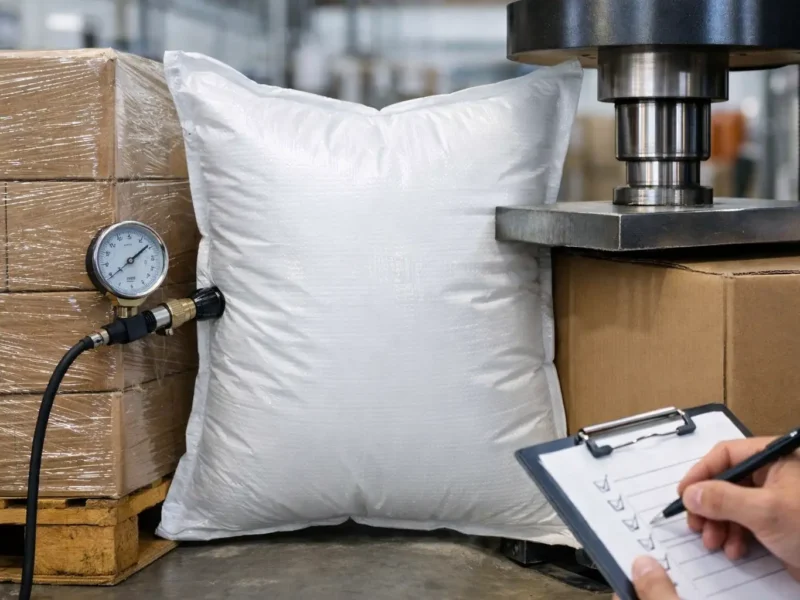
A dunnage bag that fails in transit does not usually fail without warning. The warning was often missed earlier – in material selection, valve fit, seam construction, inflation checks, or batch inspection. That is why dunnage bag quality testing matters so much to shippers moving product by truck, rail, and intermodal lanes. If a bag is expected to hold load pressure between pallets or freight units, testing has to prove more than basic inflation. It has to prove repeatable performance under real shipping conditions.
For warehouse teams and procurement managers, this is not an academic issue. A weak bag can mean shifted freight, crushed packaging, rejected deliveries, insurance claims, and labor spent reworking damaged loads. The price difference between a well-tested bag and a poorly controlled one can look minor on paper, but the cost of failure is rarely minor once a shipment is on the road or in a railcar.
What dunnage bag quality testing should cover
Good testing starts with a simple question: what is this bag being asked to do? A dunnage bag is not just an inflatable spacer. It is a load-securement component that has to manage pressure, vibration, movement, temperature changes, and handling variation. If testing only confirms that the bag inflates, it does not tell you enough.
Material strength is one of the first areas to verify. The outer layers, whether woven polypropylene, kraft, or another construction, need to resist abrasion and maintain structure while the bag is compressed between cargo surfaces. The inner bladder must hold air reliably without thinning, splitting, or leaking under expected pressure. A bag that looks acceptable on the floor can still underperform if raw materials vary from run to run.
Seam integrity is just as important. The seams are often where real-world failures begin, especially when a bag is inflated into an uneven void or pressed against hard edges. Quality testing should confirm that sealed or bonded areas hold under pressure and remain consistent across production lots. One strong sample is not enough. Buyers need confidence that the next pallet of bags will perform like the last one.
Valve performance deserves more attention than it often gets. A dunnage bag can have strong fabric and a solid bladder, but if the valve leaks, inflates inconsistently, or fails during use, the bag is compromised. Testing should confirm reliable air retention, proper valve seating, and compatibility with the intended inflator tools. In a fast-paced shipping operation, valve problems slow loading and increase the chance of underinflation or operator error.
Why real-world conditions matter
Lab checks are necessary, but they only tell part of the story. Freight environments are messy. Void sizes are not always exact. Cargo faces are not always smooth. Rail shipments create different stresses than over-the-road truckloads, and intermodal moves can stack multiple types of vibration and impact into one trip.
That is why meaningful dunnage bag quality testing should reflect actual application conditions as closely as possible. Pressure retention over time matters because shipments do not arrive in an hour. Compression behavior matters because the bag has to maintain support after the load settles. Resistance to puncture and abrasion matters because many loads involve rough packaging, strapping, corners, and imperfect surfaces.
There is also an important difference between a bag that survives ideal use and one that performs in ordinary warehouse use. If a product only works when every void is measured perfectly and every inflation step is flawless, that may not be enough for a busy dock. A dependable bag should allow for practical operating conditions, not just controlled demonstrations.
The core tests buyers should ask about
A supplier does not need to hand over a stack of technical jargon to be credible, but they should be able to explain what they test and why. Burst-related testing is one obvious category. It helps establish how much internal pressure a bag can withstand before failure. That does not mean the bag should be used anywhere near that limit, but it does show whether there is a reasonable safety margin.
Leak and air-retention testing are equally important. A bag that inflates properly and then loses pressure during transit is a problem waiting to happen. These checks should evaluate the bladder, seams, and valve together, since air loss can come from any of those points.
Compression or load-bearing performance is another critical area. The bag has to maintain enough force to stabilize cargo without collapsing prematurely. This is especially relevant when shipping dense or heavy products, where the pressure between units can change as the load moves.
Dimensional consistency should not be overlooked. If bag size varies too much from one lot to the next, fit becomes unpredictable. That can lead to poor void fill, overinflation, or wasted labor as teams try to make the bag work in an application it was not built to match.
For buyers moving freight in higher-risk channels, sample validation in the intended use case is often worth the extra step. A bag may pass standard internal testing and still need application-specific confirmation for a particular railcar, pallet pattern, or load profile. That is not a sign of poor quality. It is a sign that the shipment environment is demanding enough to justify closer review.
Manufacturing consistency is the real test
The strongest sample bag in the world does not help much if production quality drifts. In practice, the most valuable part of dunnage bag quality testing is not a single result. It is the discipline behind repeated inspection during and after production.
That includes checks on incoming materials, process controls during manufacturing, and final inspection before release. If raw materials are inconsistent, the finished bag will be inconsistent. If sealing temperatures vary, seam quality will vary. If valves are not checked for fit and retention, field performance will vary. Every one of those variables shows up later as risk in transit.
This is where experienced industrial buyers tend to separate suppliers quickly. They want to know whether quality control is built into manufacturing or only discussed after a problem occurs. A supplier with strong process control should be able to explain how they monitor batch consistency, how they address nonconforming product, and how they verify finished goods before shipment.
For companies shipping high-value or damage-sensitive product, that consistency often matters more than headline specs. Freight claims are not usually caused by the average bag. They are caused by the bad batch, the weak seam, or the valve issue that slipped through.
How to evaluate a supplier’s testing claims
Not every supplier presents testing data the same way, and not every buyer needs the same level of detail. Still, there are a few practical signals that matter. First, the supplier should be clear about what has actually been tested. Vague claims about quality are not enough. They should be able to describe the key performance checks in plain language.
Second, ask whether testing is done only on product development samples or on routine production. Those are very different things. A qualification sample can look excellent while everyday production tells a different story. What you need is confidence in delivered product, not just prototype performance.
Third, ask how the bag selection aligns with your load type. A quality bag that is wrong for the void size, load weight, or mode of transport can still fail in service. Testing and application guidance need to work together. That is especially true when comparing kraft, woven PP, or PE configurations, since each format has different handling and performance characteristics depending on the job.
This is also where a knowledgeable supplier adds value beyond the product itself. Plastix USA, for example, positions quality control as part of product performance, not as separate marketing language. That matters because testing only helps when it supports correct product selection and consistent field use.
Testing does not replace proper use
Even a well-made bag can be undermined by poor application. Underinflation reduces support. Overinflation can overstress the bag or the cargo. The wrong bag size can create unstable contact points. A poor valve-tool match can waste time and lead to inconsistent fill levels.
So while quality testing is essential, it is only one side of cargo protection. The other side is making sure the selected bag, inflation method, and placement all fit the shipment. The better the testing program, the easier that conversation becomes because the supplier understands the operating limits of the product.
Buyers should treat quality testing as proof of reliability, not a substitute for shipment planning. The goal is not to find a bag that claims to do everything. The goal is to use a bag that has been tested for the job it is actually expected to do.
If you are comparing dunnage bag options, ask the questions that get past the brochure. How is the product tested, how often is it checked, and how consistent is the production behind it? Those answers usually tell you more about future freight performance than price alone ever will.