
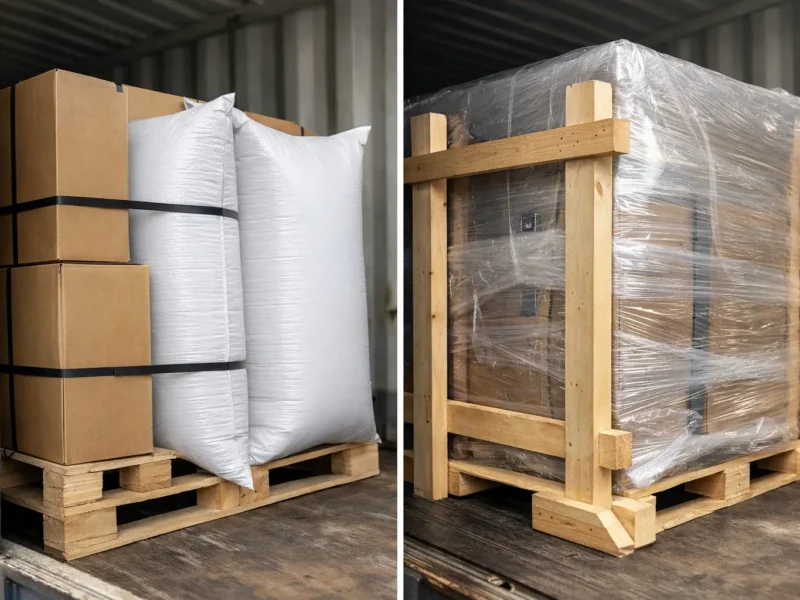
A shifted load usually gets noticed after the damage is done – at the receiver, during a claim, or when a trailer door opens to a problem nobody wants to own. That is why cargo airbags vs wood blocking is not just a packaging preference. It is a load securement decision that affects safety, labor, material handling, claim exposure, and throughput.
For many operations, wood blocking has been the default for years. It is familiar, available, and easy to understand. Dunnage airbags, on the other hand, are built specifically to fill voids and brace cargo during transit. The right answer depends on what you ship, how you ship it, and how much variation exists in your loads. But in most modern shipping environments, the comparison is less about tradition and more about performance under real operating conditions.
Cargo airbags vs wood blocking in real shipping conditions
Wood blocking works by physically restraining cargo with lumber placed against pallets, crates, or unitized loads. In the right setup, it can create a rigid barrier that helps reduce movement. That can be useful in certain applications, especially when cargo is heavy, irregular, or requires direct structural restraint.
Cargo airbags work differently. They fill open voids between loads and apply even pressure across a broader contact area. Once inflated correctly, they help stabilize freight by limiting lateral and longitudinal movement during normal transit vibration, braking, and impact. That broader contact matters because many damaged loads do not fail at one hard point. They fail because pressure concentrates unevenly as freight shifts over time.
For truckload freight with consistent pallet patterns, airbags often provide faster and more repeatable void fill than cutting, placing, and securing wood. In rail and intermodal shipping, where impact forces are more aggressive, proper bag selection becomes even more important. Bag level, burst strength, valve quality, and fit to the void all matter. A poor bag choice can underperform just as easily as poorly installed wood.
Where wood blocking still makes sense
Wood blocking is not obsolete. It still has a place in load securement.
If a shipment includes very heavy machinery, steel components, or cargo with hard edges that can puncture inflatable products, wood may be part of the better solution. The same is true when the load geometry leaves no practical way to place an airbag in a usable void, or when a blocking and bracing plan requires fixed restraint points.
Some shippers also prefer wood because their teams already know the method, the material is stocked on site, and the load profile rarely changes. In that narrow case, wood can seem like the simpler option.
But that simplicity often disappears when labor time, trailer variability, disposal, and consistency are examined closely. Wood blocking is only as good as the cut, placement, fastening method, and floor compatibility. If the block is too short, poorly anchored, or installed inconsistently across shifts, its reliability drops quickly.
Why more operations move toward dunnage airbags
Airbags are designed for one job: filling voids and stabilizing cargo efficiently. That purpose-built advantage shows up on the dock.
First, they reduce installation time. A trained team can place and inflate a bag much faster than measuring, cutting, staging, and fastening wood. In high-volume shipping operations, those minutes matter. Faster trailer turns and more consistent loading procedures translate directly into labor savings.
Second, airbags can improve load contact. Wood blocks restrain at specific points. Airbags expand to meet the surfaces around them, which can create a more uniform brace between pallet loads or unitized products. That helps limit progressive movement during transit.
Third, airbags reduce the handling burden. Lumber is heavier, bulkier, and harder to move around the dock. Airbags take up less storage space and are easier for loading crews to position. That matters in facilities where floor space is tight and loading speed is under pressure.
There is also the issue of damage risk caused by the securement method itself. Wood can create concentrated pressure points, scrape packaging, or crush weaker load faces if installed aggressively. A properly specified dunnage bag applies pressure more evenly, which can be a better fit for many palletized consumer goods, packaged industrial materials, paper products, and similar freight.
Cost is not just material cost
On paper, wood blocking may look inexpensive. A few pieces of lumber can seem cheaper than an engineered dunnage airbag. But material price alone rarely tells the full story.
The true cost includes labor, storage, handling, waste, training consistency, and claims. Wood usually takes more time to prepare and install. It consumes more warehouse space. It often generates more cleanup and disposal at destination. If blocking is nailed or otherwise fixed, it may also create issues for trailer floors or customer equipment.
Airbags usually cost more per unit than scrap lumber, but they often lower the total installed cost of securement. Less labor, faster loading, cleaner unloading, and more consistent application all contribute to that equation. If the result is fewer shifted loads and fewer damage claims, the cost comparison changes even more.
For procurement teams, this is where the analysis should stay grounded. The lowest-cost material is not always the lowest-cost system.
Safety and consistency on the dock
Safety is another practical difference in cargo airbags vs wood blocking.
Wood blocking introduces cutting tools, saw stations, splinters, nails or fasteners, and more manual handling. Each step adds exposure. Even in disciplined operations, more touchpoints mean more chances for injury or inconsistency.
Airbags simplify the process when crews are trained and using the right inflator tools. Placement is straightforward, and inflation can be controlled to the proper pressure for the application. There is still a process to follow, but it is generally cleaner and easier to standardize across teams, shifts, and locations.
Consistency matters because load securement failures often come from variation, not intent. One loader uses a different block length. Another skips a fastening step. Another inflates a bag incorrectly or uses the wrong level bag for the void and transport mode. The best operations reduce those variables with clear standards and quality materials.
That is where product quality becomes a serious buying factor. A dunnage bag is only dependable if the materials, valve performance, and testing behind it are dependable. Buyers comparing bag options should look beyond price and ask how the product is manufactured, tested, and matched to the shipment.
The mode of transport changes the answer
Truck, rail, and intermodal do not apply the same forces.
In over-the-road truck shipments, airbags are often a strong fit for palletized and unitized goods with predictable voids. They are efficient and can perform well when selected correctly for the load weight and gap size.
Railcar shipping is a tougher environment. Impact, coupling forces, and longer transit duration require more careful bracing decisions. In many rail applications, airbags are used successfully, but only when the correct bag construction and placement method are chosen. Some loads may still require wood as part of a broader blocking and bracing plan.
Intermodal adds its own complexity because the load may experience multiple handling events and shifting force directions. That makes securement design more important than any single material choice. In some cases, a combined approach is the right one.
When a hybrid method is the better answer
This is not always an either-or decision.
Some shipments benefit from wood blocking at the base or around heavy irregular items, with airbags used to fill side or center voids. That can provide the rigidity of wood where direct restraint is needed and the adaptive contact of airbags where void fill is the main problem.
A hybrid approach is often the most practical answer for mixed loads, uneven product geometry, or complex rail shipments. The goal is not to force one method onto every load. The goal is to secure freight with the least risk and the best operational efficiency.
For that reason, load type should lead the decision. Weight distribution, package strength, void size, transport mode, and loading pattern all matter. So does the ability of your team to apply the method correctly every time.
How to choose the right securement method
If your operation ships consistent palletized products with repeatable voids, dunnage airbags usually offer better speed, cleaner application, and better scalability than wood blocking. If your freight is highly irregular, extremely heavy, or vulnerable to puncture conditions, wood may still be necessary in part or in full.
If claims are rising, loading labor is tight, or destination cleanup is becoming a customer complaint, that is usually a sign to reevaluate the current method. It is also the point where technical guidance matters. The right bag type, size, and inflation setup can make the difference between a reliable system and a preventable failure.
At Plastix USA, that conversation is practical. The load, the void, the mode, and the risk determine the recommendation – not a one-size-fits-all answer.
The better question is not whether wood or airbags have been used longer. It is which method gives your freight the right restraint, at the right cost, with the fewest problems between the dock and the receiver.