
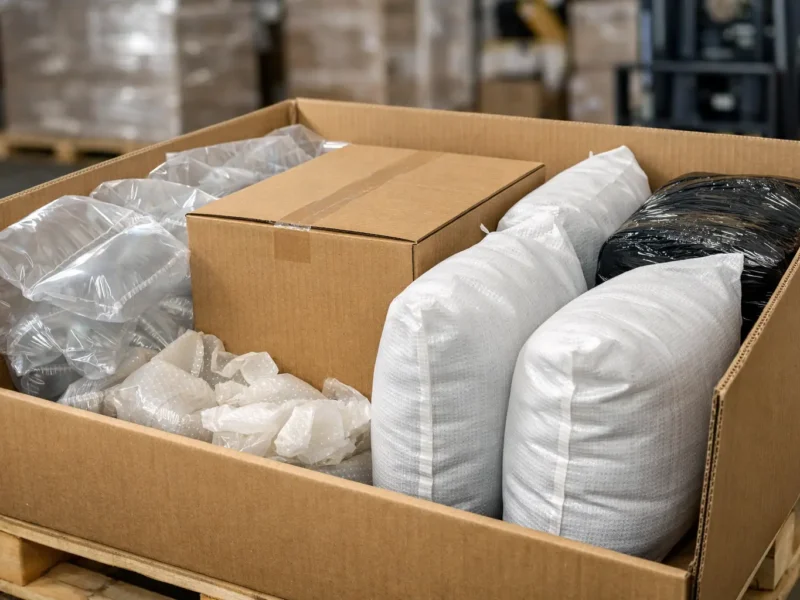
A load that leaves the dock looking tight can still arrive with crushed product, broken pallets, and a claim nobody wants to own. In most cases, the problem is not the trailer or railcar. It is the empty space inside it. Choosing the best void fillers for freight starts with understanding how that space behaves once the load is exposed to braking, vibration, lateral movement, and impact.
For warehouse managers, packaging engineers, and freight teams, void fill is not a minor accessory. It is a load-securing decision that affects product condition, labor time, material cost, and customer satisfaction. The right solution depends on what you ship, how large the void is, and whether the load is moving by truck, rail, or intermodal.
What makes a void filler effective in freight
A good void filler does one job well. It controls movement by occupying space and helping transfer pressure where the load can handle it. That sounds simple, but freight conditions are not simple. Trailer vibration, uneven roads, rail impact, and shifting weight all change the forces inside a shipment.
An effective void filler needs the right level of compressive strength for the application. If it collapses too easily, it will not stabilize the load. If it is too rigid for the product or stacking pattern, it can create point pressure and damage cartons, pails, or unitized goods. The best option also has to work efficiently on the floor. If installation is slow or inconsistent, performance suffers and labor costs rise.
That is why there is no single best material for every shipment. The best void fillers for freight are the ones matched to the load profile, transit mode, and risk level.
Best void fillers for freight by application
Dunnage air bags
For many truck, railcar, and intermodal shipments, dunnage air bags are the most effective option for blocking and bracing large voids between loads. They are designed to fill lateral or longitudinal gaps and apply broad, controlled pressure across the load face. When properly sized and inflated, they help prevent movement without the overbuilt weight and handling issues that come with wood blocking.
This is where application details matter. A light palletized consumer load moving over the road does not need the same bag construction as a heavy industrial load in a railcar. Bag material, size, burst performance, and valve quality all affect results. PP woven and kraft dunnage bags are common choices, with different performance profiles depending on required strength, handling conditions, and cost targets.
Dunnage air bags are especially strong when the void is too large for paper fill or foam corner protection to do much good. They also make sense when labor efficiency matters, since crews can install and inflate them quickly with the proper tools. The trade-off is that they must be correctly selected and placed. An undersized bag, poor contact area, or incorrect inflation level can turn a strong solution into a weak one.
Corrugated void fill and honeycomb board
Corrugated pads, multi-layer paperboard, and honeycomb structures are often used when the void is smaller or when the goal is to separate products and reduce light movement. These materials are useful in palletized shipments where there is some open space but not enough to justify an air bag. They can also help distribute load pressure between uneven surfaces.
The advantage is simplicity. Corrugated solutions are easy to stock, easy to cut, and familiar to most shipping operations. They also work well in dry environments and can be cost-effective for lighter loads.
Their limitation is compression strength over time. In higher-weight applications or long transit cycles, paper-based fillers can deform and lose holding power. They are not usually the best choice for large voids in heavy freight, especially in rail or rough intermodal conditions.
Foam blocks and pads
Foam is commonly used when product surfaces need cushioning in addition to void fill. It can protect sensitive finishes, irregular shapes, and fragile components while occupying small gaps. In some specialty shipments, foam performs well because it conforms better than rigid paper products.
For general freight securement, though, foam is usually a secondary material rather than the primary answer. It is better suited to shock absorption and surface protection than to controlling large-scale load shift. It also creates disposal concerns in some operations and may not deliver the most efficient cost-to-performance ratio for standard pallet freight.
Wood blocking and bracing
Wood remains part of many freight programs, especially for very heavy loads, machinery, or shipments with unusual center-of-gravity concerns. It provides rigid restraint and can be built to suit difficult load geometries.
The downside is labor, consistency, and weight. Wood systems take time to build, can vary by crew, and increase handling demands. For many routine palletized loads, they are more than what is needed. In applications where speed, standardization, and trailer utilization matter, inflatable void fill often replaces a significant portion of wood bracing.
Paper void fill systems
Crumpled kraft paper and converted paper systems are widely used in parcel packaging, but they have limited value in full-scale freight void management. They can help stabilize lighter cartons inside larger containers or support small interior spaces within a unit load. Once voids get wider and load mass increases, paper fill loses practical effectiveness.
That does not make paper useless. It just means it belongs in the right part of the packaging system. For interior carton voids, it can be a solid choice. For trailer or railcar load gaps, it is rarely the best performer.
How to choose the best option for your load
The first question is void size. Small gaps may only need corrugated or foam support. Larger gaps between pallet loads usually call for dunnage air bags because they can expand to fit the space and apply consistent pressure over a broad area.
The second question is load weight and stacking strength. A strong, unitized pallet can tolerate different bracing pressure than fragile cartons or partially supported product. If the load face cannot take pressure, the answer may involve redesigning the unit load, adding slip sheets or stabilizers, or using a different void-fill approach.
Transit mode matters just as much. Truck shipments generally face less severe impact than rail, while intermodal can expose freight to repeated handling and variable conditions. A filler that performs acceptably in short-haul truckload may fail in rail service if it is not rated and selected correctly.
Then there is the question buyers deal with every day: operational efficiency. The best material on paper is not the best material if crews avoid using it, misuse it, or lose time installing it. Reliable performance depends on repeatable processes. That is one reason many shippers standardize around dunnage airbags for common freight lanes. They are fast, scalable, and adaptable across different load plans when matched correctly.
Where dunnage airbags usually outperform other void fillers
When freight teams ask what works best across the widest range of shipping conditions, dunnage airbags are often the leading answer. They fill substantial voids without adding much weight. They install quickly. They reduce the need for custom wood blocking. And they can be matched to truck, railcar, or intermodal requirements with the right construction and performance level.
They also support a cleaner standard operating procedure. Instead of cutting and fitting multiple rigid materials for each load pattern, crews can work with defined bag sizes, inflation tools, and placement rules. That kind of consistency helps reduce variation between shifts and facilities.
Still, airbags are not automatic fixes. They need proper contact with the load, correct gap sizing, and inflation control. Valve quality and bag construction also matter. A low-grade bag may look acceptable before use but fail when pressure and transit stress increase. For buyers responsible for claims prevention, that is not a small detail. It is the whole decision.
Manufacturers such as Plastix USA focus on this part of the equation because material quality, testing discipline, and application guidance directly affect field performance. If you are using airbags as a core freight securement method, supplier reliability is part of the product.
The cost question buyers should really ask
Too many void-fill decisions are made on unit price alone. That usually leads to false savings. The better question is cost per protected load. A cheaper filler that increases damage, labor, or inconsistency is not cheaper in real operating terms.
The right comparison includes claim reduction, packing speed, trailer or railcar utilization, inventory simplicity, and disposal impact. In many freight programs, the best-performing void filler is the one that reduces exceptions and keeps the shipping process predictable.
That often points to a combination rather than a single material. Dunnage airbags may handle the main void. Corrugated may help with layer separation. Foam may protect a vulnerable edge. Good freight packaging is usually a system, not a single component.
Empty space is never really empty once a shipment starts moving. It becomes momentum, pressure, and damage risk. The best choice is the void filler that fits your load, holds up in your transit conditions, and works the same way every time your team uses it.