
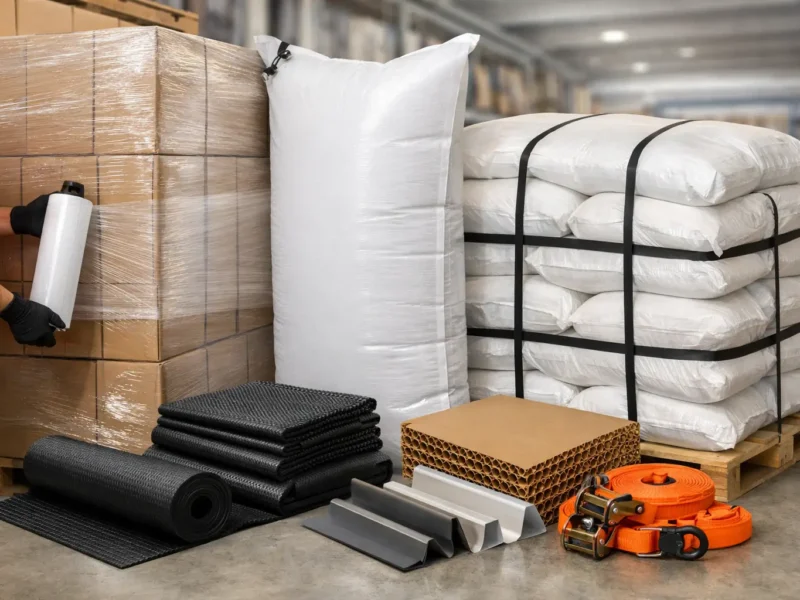
A shifted load usually shows up after the damage is done – crushed corners, broken pallets, rejected deliveries, and a claim nobody wanted to file. That is why choosing the best load stabilization products is not a minor packaging decision. It is a freight-risk decision that affects cargo condition, labor time, trailer utilization, and the consistency of every shipment leaving your dock.
For most industrial shippers, there is no single product that solves every movement problem. The right answer depends on what is being shipped, how much void space exists, the transport mode, the load weight, and how repeatable the shipping pattern is. A warehouse moving uniform pallet loads by truck will not need the same solution as a manufacturer shipping heavy product by railcar or intermodal container.
What the best load stabilization products actually do
Load stabilization products are designed to control movement during transit. That sounds simple, but movement happens in several ways. Freight can shift laterally, creep forward and backward, tip under vibration, or collapse when stack pressure changes. The best-performing products reduce one or more of those risks without creating unnecessary labor or material cost.
A good stabilization system also needs to fit real operations. If a product performs well in theory but slows loading, requires excessive training, or produces inconsistent installation, it may not be the best option on the floor. For most B2B shippers, performance and repeatability matter just as much as price per unit.
Best load stabilization products by application
Dunnage airbags
For many truck, rail, and intermodal applications, dunnage airbags are among the best load stabilization products available because they address one of the most common causes of cargo damage – unfilled void space. When properly sized and inflated, they brace loads and limit side-to-side or longitudinal movement between pallets, unitized freight, or rigid cargo groupings.
Their value is especially clear when loads cannot be packed tightly enough to prevent transit motion on their own. In those cases, the airbag becomes an active bracing component rather than just filler. Different constructions matter here. PP woven dunnage bags are often chosen for demanding freight environments where durability and consistent burst performance are important. Kraft options may fit lighter-duty applications or customers with specific handling preferences. PE airbags can also be a fit depending on load profile and securement requirements.
The trade-off is that airbags are not one-size-fits-all. Incorrect dimensions, underinflation, overinflation, or poor placement can reduce performance. Valve style and inflator compatibility also affect loading speed. If void size, load weight, and transport mode are not considered together, even a good bag can become the wrong solution.
Void fill and blocking materials
Not every load needs an inflatable product. Corrugated void fill, foam components, and rigid blocking materials can work well in controlled applications where the cargo geometry is predictable and the movement risk is limited. These products are often useful for lighter shipments, smaller spaces, or situations where inflation tools are not practical.
Their advantage is simplicity. They can be easy to stage, easy to train on, and effective when the same load configuration repeats day after day. The limitation is that they usually do not provide the same adaptable pressure or broad-area bracing as a properly selected dunnage airbag. For heavier industrial loads, especially in rail or long-haul truck lanes, rigid or light fill materials may not be enough by themselves.
Friction mats and anti-slip materials
Some freight does not need to be pushed apart to stay in place. It needs more resistance at the base. Friction mats and anti-slip sheets increase the coefficient of friction between pallets, product, and trailer floor surfaces. That can reduce sliding and help other securement methods perform better.
These products are often underused because they are less visible than airbags or straps, but they can be highly effective in the right setup. They are particularly useful when smooth pallet bottoms or slick trailer floors contribute to movement. Still, anti-slip materials are usually part of a system, not the whole system. If there is significant open space between loads, friction alone will not control impact forces.
Strapping and banding
Strapping is often essential for unitizing product before it is ever loaded into a trailer or container. Steel or polyester strap can hold cartons, bundles, or materials tightly to a pallet and reduce internal load breakup. This is different from trailer-level stabilization, but it plays a major role in transit protection.
The strength of strapping is load containment. The weakness is that it does not automatically prevent the entire unit load from shifting in the conveyance. A tightly strapped pallet can still slide or tip if it is not braced correctly. That is why strapping works best when paired with pallet design, stretch wrap, corner protection, and, where needed, dunnage or friction support.
Stretch wrap and stretch hooding
Stretch wrap remains one of the most common stabilization tools in shipping because it is flexible, widely available, and well understood in warehouse operations. It helps keep cartons together, improves pallet integrity, and can reduce minor movement during handling and transit.
But stretch wrap is often asked to do more than it should. If a load has large voids around it, high center-of-gravity issues, or significant exposure to shock and vibration, wrap alone may not control movement. Wrapping tighter is not always the answer either. Too much containment force can damage cartons or deform product. The best result comes from matching film performance to the pallet pattern and then adding other stabilization measures where the transport risk justifies it.
Load bars, decking bars, and physical restraints
In truckload applications, load bars and related restraints can create direct separation between cargo sections and reduce forward or rearward movement. They can be practical for certain trailer configurations, especially when loads are stacked in a way that allows secure bar placement.
Their main limitation is coverage. Bars restrain at specific points, not across the full contact area of the load. For uneven freight, mixed pallets, or railcar movement, they may be less effective than products designed to fill voids or distribute pressure more broadly.
How to choose the best load stabilization products
The first question is not which product is cheapest. It is what type of movement is causing risk. If cargo is sliding, friction may need attention. If it is spreading apart inside the trailer, void fill or airbags may be the priority. If the pallet itself is failing, unitization needs work before trailer securement is addressed.
Transport mode matters just as much. Truck shipments face braking, cornering, and road vibration. Rail adds higher impact forces and longer-duration movement. Intermodal combines several handling environments in one trip. A product that works in regional truck lanes may not be enough for railcar service.
Load consistency is another deciding factor. If you ship the same dimensions every day, a highly optimized material setup can lower cost and improve speed. If load profiles vary by order, a more adaptable stabilization product often makes more sense. This is one reason dunnage airbags are widely used across industrial freight – they can accommodate a range of void sizes and cargo patterns when properly specified.
You also need to consider labor. The best product on paper can fail in practice if installation is slow, confusing, or easy to get wrong. Valve quality, inflation tool performance, and packaging format all affect throughput. In busy operations, those details matter.
Common mistakes that reduce performance
One of the most common mistakes is treating all dunnage bags as interchangeable. Material construction, ply strength, valve reliability, and manufacturing consistency directly affect field performance. Another is choosing size based only on the visible gap rather than the weight and movement characteristics of the load.
Shippers also lose protection when they rely on a single method to solve every issue. Stretch wrap cannot compensate for major trailer voids. Strapping cannot stop base sliding on a slick floor. An anti-slip mat cannot stabilize a badly distributed top-heavy pallet by itself. Good freight protection usually comes from combining products that address different types of motion.
Quality control should not be overlooked, especially in high-volume shipping programs. Consistent manufacturing and testing matter because small variations become expensive when repeated across hundreds or thousands of shipments. Buyers responsible for claims prevention usually care less about promotional language and more about whether the product performs the same way every time.
When airbags are the better answer
If your main issue is open space between palletized or unitized loads, airbags are often the most efficient answer because they turn wasted space into active support. They are particularly effective when freight patterns create repeatable voids in truck trailers, railcars, or intermodal containers and when the cargo itself can accept distributed bracing pressure.
That does not mean every shipment should use them. Very small gaps, fragile surfaces, unstable pallet construction, or unusual load shapes may require a different approach or a combined system. But for many industrial shippers, airbags offer a strong balance of protection, loading speed, and cost control. Companies that want dependable performance typically benefit from working with a supplier that can recommend bag type, size, and inflation setup based on actual shipping conditions. That is where an experienced manufacturer such as Plastix USA can save time and reduce guesswork.
The best load stabilization products are the ones that match your freight reality, not a generic checklist. If you start with how the load moves, where the voids are, and what your team can install consistently, the right product choice usually becomes clear.